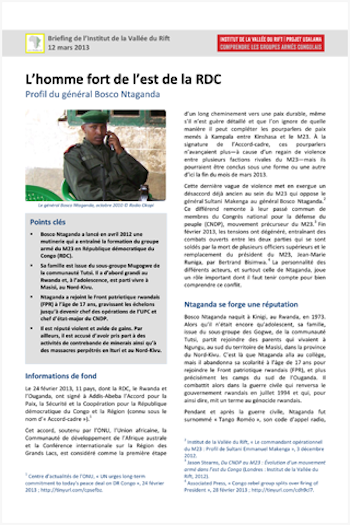
Ce briefing du Projet Usalama présente un profil de l’un des commandants les plus importants du M23, le général Bosco Ntaganda. Malgré son inculpation par la Cour pénale internationale sur des accusations d’enrôlement et utilisation d’enfants soldats, de meurtre,…
RVI publishes books, research reports, research papers, briefings and meeting reports in a range of formats. Publications cover policy, research, arts, culture and local knowledge in the countries of eastern and central Africa. Research publications—books, reports and papers—are peer-reviewed. Some RVI publications are also available in French and/or Arabic.
The RVI is a signatory of the Budapest Open Access Initiative (2001); all publications are free for download in PDF format under Creative Commons licences. The views expressed in books and reports published by the RVI are those of the authors, not the Institute.
SEARCH
PUBLICATION TYPE
LANGUAGE
REGION
COUNTRY
- By Emily Paddon
- Download
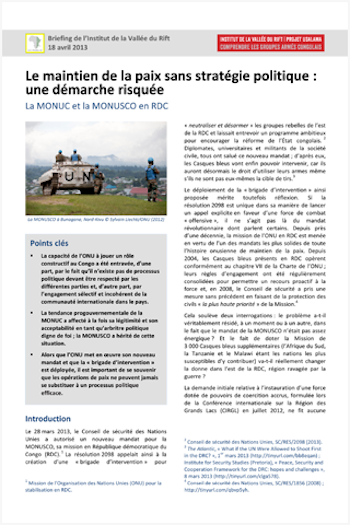
Ce briefing du Projet Usalama expose l’histoire de la participation de l’ONU dans l’est de la RDC et analyse les défis qui continuent de faire face à la mission, même au moment où elle se prépare à déployer une…
- By Jason Stearns
- Download
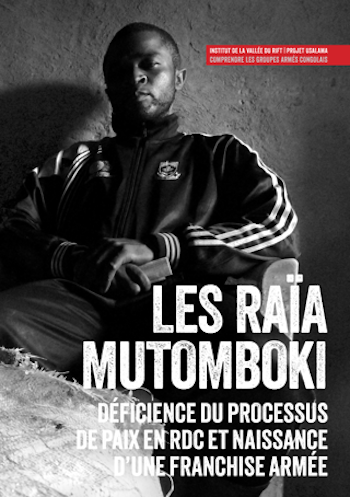
Ce rapport du Projet Usalama décrit les origines, l’évolution rapide, l’expansion et les activités de cette force diverse. Le groupe débuta comme une réponse locale à l’insécurité endémique, mais profita des déficiences dans les différents processus de paix à…
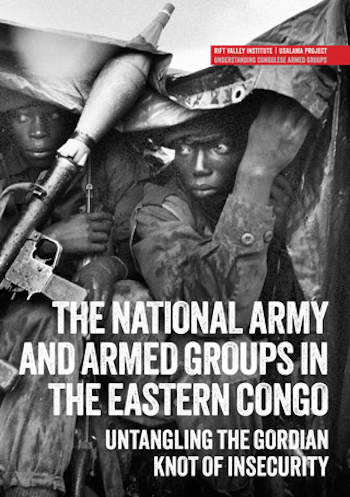
Key points The RVI Usalama Project addresses the lack of detailed information about Congolese armed groups. The Institute has published fourteen reports and briefings on armed groups operating in the eastern DRC (including the Congolese national army, the FARDC)….
- By Michel Thill
- Download
Points clés Le Projet Usalama de l’Institut de la Vallée du Rift (RVI) a pour mission de pallier l’absence d’informations détaillées sur les groupes armés congolais. L’Institut a publié 14 rapports et documents d’information sur les groupes armés qui opèrent…
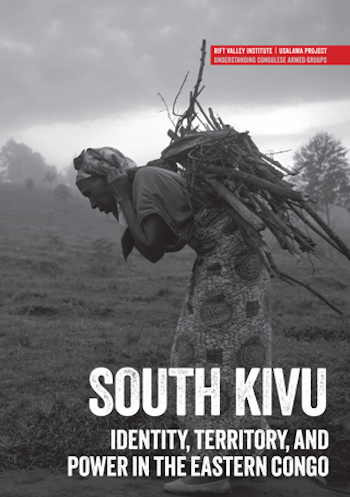
This Usalama report by Koen Vlassenroot outlines the historical dynamics behind the armed movements in South Kivu, focusing on the period before and leading up to the First Congo War. The province of South Kivu has been at the…
The Usalama Project is a gold mine of accessible information on Congolese armed groups. Its studies are, and will be, of great use for security sector reform in the Democratic Republic of the Congo. EMMANUEL KABANGELE, NATIONAL COORDINATOR, RRSSJ…
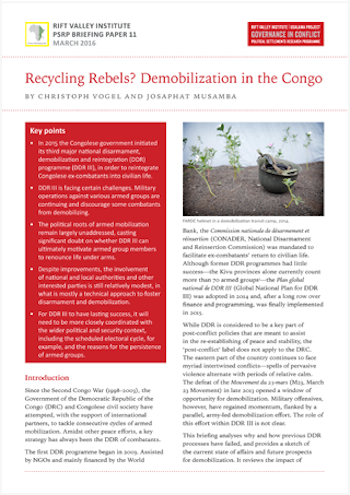
Since the Second Congo War (1998–2003), the Government of the Democratic Republic of the Congo (DRC) and Congolese civil society have attempted, with the support of international partners, to tackle consecutive cycles of armed mobilization. Amidst other peace efforts,…
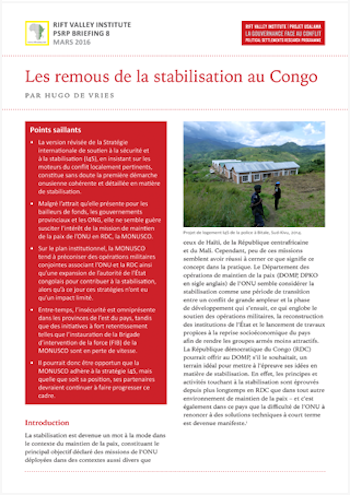
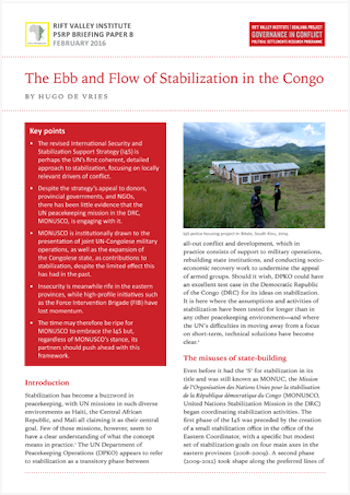
La stabilisation est devenue un mot à la mode dans le contexte du maintien de la paix, constituant le principal objectif déclaré des missions de l’ONU déployées dans des contextes aussi divers que ceux de Haïti, de la République…
<p>Stabilization has become a buzzword in peacekeeping, with UN missions in such diverse environments as Haiti, the Central African Republic, and Mali all claiming it as their central goal. Few of these missions, however, seem to have a clear…
Recent Publications

State Capture in Africa: How elite networks undermine democracy, development and security
June 24, 2026
Key points State capture has been increasingly recognized as a major governance challenge due to the way it helps to drive many of the most pressing problems facing contemporary states, including democratic erosion, corruption, economic exclusion, insecurity and declining trust

The New Geopolitics of Eastern Africa
June 17, 2026
On 20 May, the British Institute of Eastern Africa (BIEA), Chatham House, and the Rift Valley Institute (RVI) convened a group of experts to discuss the ‘The New Geopolitics of Eastern Africa’. The closed-door roundtable considered the ongoing transformation of

Commodification and Conflict in the Horn of Africa Borderlands
April 1, 2026
This report synthesizes findings from the Rift Valley Institute’s X-Border Local Research Network (2019–2025). In the surveyed studies, 25 leading local and international area specialists conducted extensive qualitative fieldwork across borderlands in South Sudan, Sudan, Ethiopia, Kenya and the Somali