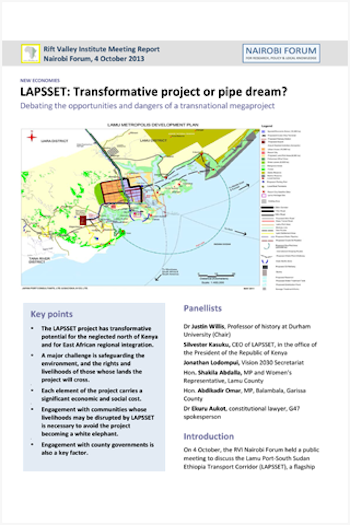
Key points The LAPSSET project has transformative potential for the neglected north of Kenya and for East African regional integration. A major challenge is safeguarding the environment, and the rights and livelihoods of those whose lands the project will…
RVI publishes books, research reports, research papers, briefings and meeting reports in a range of formats. Publications cover policy, research, arts, culture and local knowledge in the countries of eastern and central Africa. Research publications—books, reports and papers—are peer-reviewed. Some RVI publications are also available in French and/or Arabic.
The RVI is a signatory of the Budapest Open Access Initiative (2001); all publications are free for download in PDF format under Creative Commons licences. The views expressed in books and reports published by the RVI are those of the authors, not the Institute.
SEARCH
PUBLICATION TYPE
LANGUAGE
REGION
COUNTRY
تُعتبر كفيا قنجي الواقع على الطرف الغربي الأقصى للسودان نقطة إلتقاء رئيسية بين دارفور وجنوب البلاد؛ وتخضع هذه المنطقة الغنية بالمعادن حالياً لإدارة جنوب دارفور، لكن من المتوقع إعادتها إلى مقاطعة راجا في جنوب السودان بموجب بنود اتفاقية السلام…
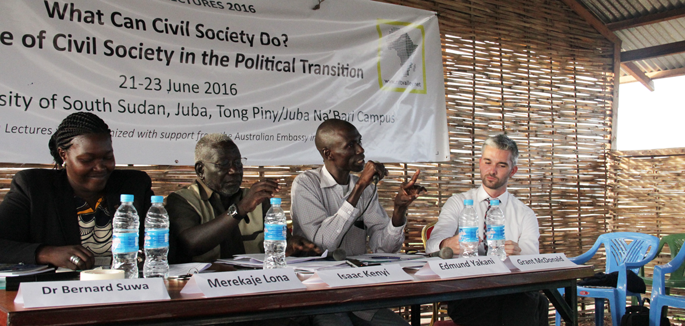
In South Sudan delays in the making of the national constitution have led to public concern. My Mother Will Not Come to Juba: South Sudanese debate the constitution is the record of three evenings of public lectures at the University of…
In December 2013, South Sudan descended into conflict. Peace initiatives over the following eighteen months culminated in an agreement between government and armed opposition, signed in August 2015. While the agreement came into effect in late 2015, many uncertainties…
On Friday, 27 February 2015, the Nairobi Forum invited author Eddie Thomas to launch his new book South Sudan: A Slow Liberation in a panel discussion at RVI’s office in Nairobi. Peter Biar Ajak of the Centre for Strategic…
‘The conference has put into perspective what stabilization means in South Sudan as opposed to what it means in Somalia and in the DRC. And putting my own insights on stabilization alongside those of the speakers here has given…
With the formation of a Transitional Government of National Unity (TGoNU) and the subsequent outbreak of violence in Juba in July 2016, the role of civil society in South Sudan is more vital than ever. Can a civil society,…
In April 2016, seventeen chiefs from different parts of South Sudan gathered in Kuron Holy Trinity Peace Village, in Eastern Equatoria, to discuss the role of customary authority in governance—past and present—and their own contribution to peacemaking and a…
South Sudan’s political culture, including its current civil war, is international. This is due to the country’s history of mass migration and displacement, particularly during the last two civil wars from the early 1960s. By the end of the…
South Sudan’s civil war has spread across the country, fuelling economic collapse and food shortages, and sending millions of residents fleeing across its borders. Although the former Northern Bahr el-Ghazal State has escaped the worst excesses of the current…
Recent Publications

SHECONF 2026: International Conference on Social Sciences and Humanities
July 9, 2026
Event report On 26 March 2026, researchers, practitioners and academics gathered in Addis Ababa for SHECONF 2026, an International Conference on Social Sciences and Humanities in Ethiopia, the first of its kind convened by the Ethiopian Women Researchers Network (EWNET).

State Capture in Africa: How elite networks undermine democracy, development and security
June 24, 2026
Key points State capture has been increasingly recognized as a major governance challenge due to the way it helps to drive many of the most pressing problems facing contemporary states, including democratic erosion, corruption, economic exclusion, insecurity and declining trust

The New Geopolitics of Eastern Africa
June 17, 2026
On 20 May, the British Institute of Eastern Africa (BIEA), Chatham House, and the Rift Valley Institute (RVI) convened a group of experts to discuss the ‘The New Geopolitics of Eastern Africa’. The closed-door roundtable considered the ongoing transformation of