Introduction Galmudug state in Somalia was, until recently, seen as a region of conflict and fragmentation, shaped by the legacy of violence passed down from the Somali civil war. Due to the constant conflict between clan-based political groupings, it…
RVI publishes books, research reports, research papers, briefings and meeting reports in a range of formats. Publications cover policy, research, arts, culture and local knowledge in the countries of eastern and central Africa. Research publications—books, reports and papers—are peer-reviewed. Some RVI publications are also available in French and/or Arabic.
The RVI is a signatory of the Budapest Open Access Initiative (2001); all publications are free for download in PDF format under Creative Commons licences. The views expressed in books and reports published by the RVI are those of the authors, not the Institute.
SEARCH
PUBLICATION TYPE
LANGUAGE
REGION
COUNTRY
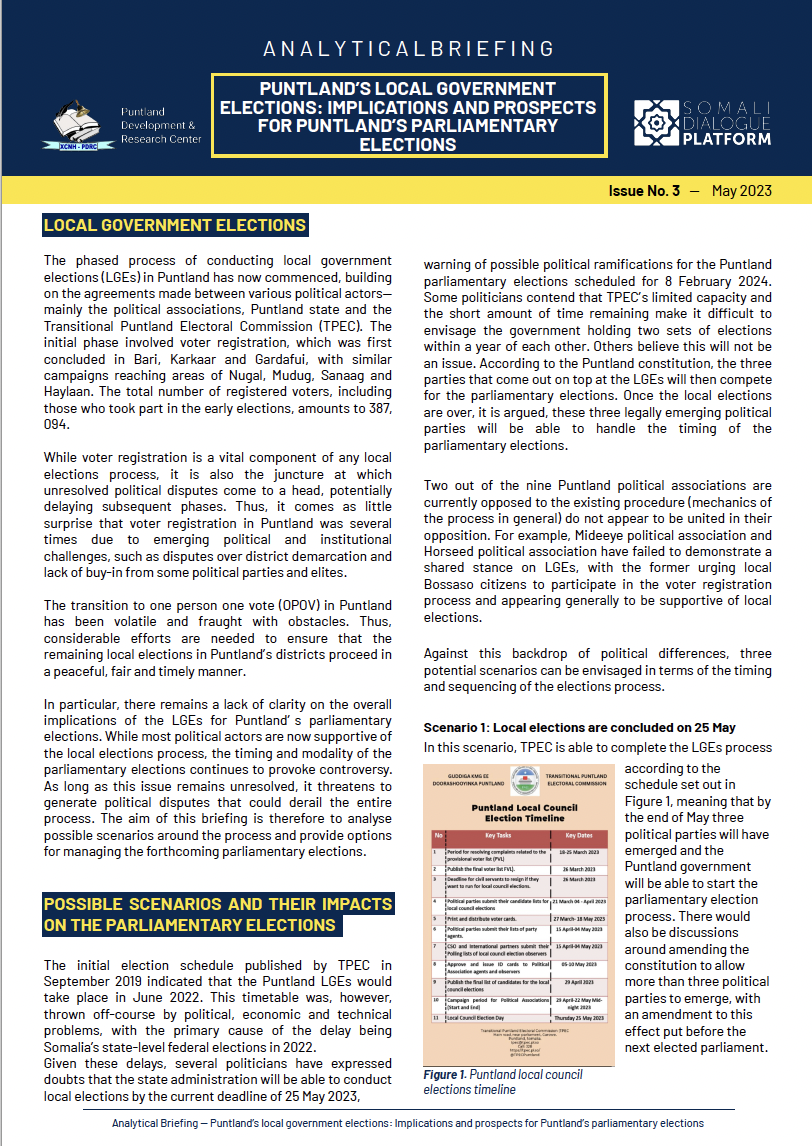
LOCAL GOVERNMENT ELECTIONS The phased process of conducting local government elections (LGEs) in Puntland has now commenced, building on the agreements made between various political actors— mainly the political associations, Puntland state and the Transitional Puntland Electoral Commission (TPEC)….
Overview Amid the major changes to Somalia’s political landscape seen over the past two decades, an abiding feature has been the reliance on clan-based power-sharing models, including the ‘4.5’ formula. Despite the Somali Provisional Constitution containing no reference to…
Overview Since the formation of Jubaland state in 2012, decades of conflict have given way to increased stability across parts of the region. Even so, insecurity, political violence and humanitarian crises have persisted amid recurrent tensions between Jubaland and…
- By Mustafe M. Abdi
- Download
The current conflict over the contested city of Lasanod has the potential to expand into a crisis affecting several of the Somali-speaking territories. This blog – building on research the author conducted in 2021 – looks at the conflict…
- By Abdirahman Edle
- Download
The site of recurrent famines and humanitarian crises, Somalia’s Bay and Bakool regions were once considered the country’s breadbasket. In this blog, researcher and former development worker Abdirahman Edle explains how, over the past two decades, the region has…
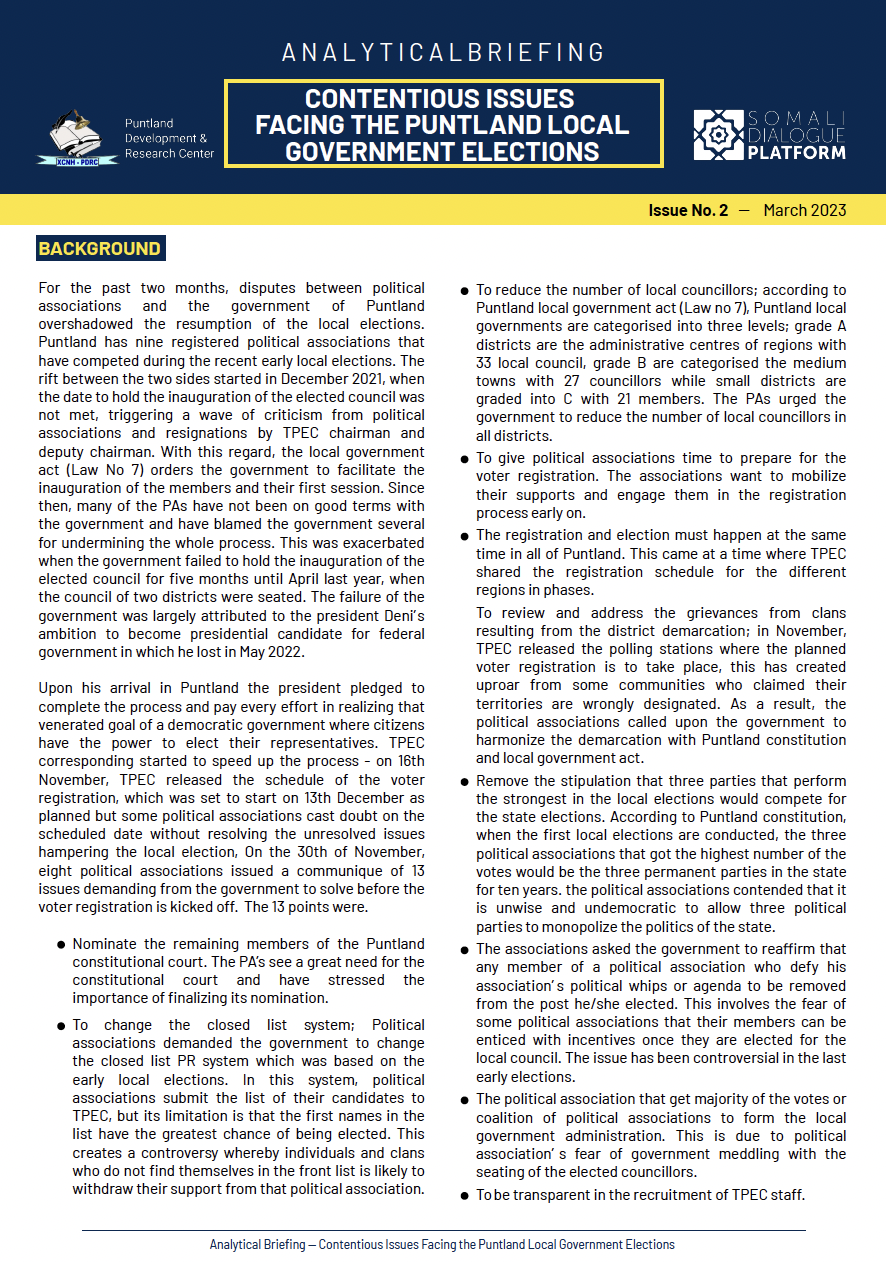
BACKGROUND For the past two months, disputes between political associations and the government of Puntland overshadowed the resumption of the local elections. Puntland has nine registered political associations that have competed during the recent early local elections. The rift…
Overview: Hirshabelle’s volatile political settlement Hirshabelle has been the site of continued political instability since its hasty formation as a Federal Member State (FMS) in October 2016, combining the two regions of Hiiraan and Middle Shabelle. Throughout the process,…
OVERVIEW Since 2012, when the internationally recognized Federal Government of Somalia (FGS) replaced the Transitional Federal Government (TFG), Somalia has sought to expand its process for selecting its leaders towards more democratic forms. So far, progress towards universal suffrage…
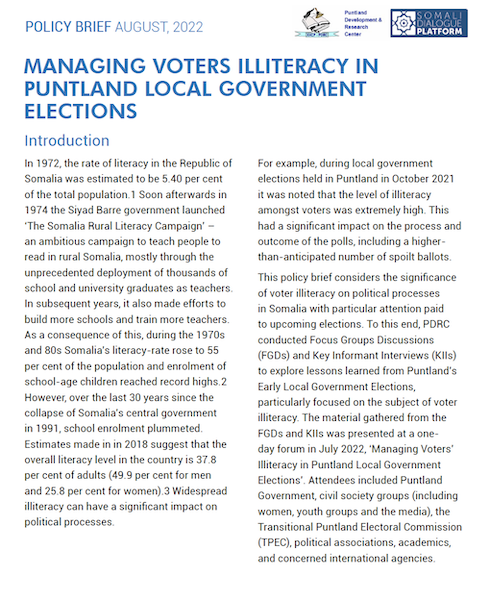
In 1972, the rate of literacy in the Republic of Somalia was estimated to be 5.40 per cent of the total population. Soon afterwards in 1974 the Siyad Barre government launched ‘The Somalia Rural Literacy Campaign’ – an ambitious campaign…
Recent Publications

SHECONF 2026: International Conference on Social Sciences and Humanities
July 9, 2026
Event report On 26 March 2026, researchers, practitioners and academics gathered in Addis Ababa for SHECONF 2026, an International Conference on Social Sciences and Humanities in Ethiopia, the first of its kind convened by the Ethiopian Women Researchers Network (EWNET).

State Capture in Africa: How elite networks undermine democracy, development and security
June 24, 2026
Key points State capture has been increasingly recognized as a major governance challenge due to the way it helps to drive many of the most pressing problems facing contemporary states, including democratic erosion, corruption, economic exclusion, insecurity and declining trust

The New Geopolitics of Eastern Africa
June 17, 2026
On 20 May, the British Institute of Eastern Africa (BIEA), Chatham House, and the Rift Valley Institute (RVI) convened a group of experts to discuss the ‘The New Geopolitics of Eastern Africa’. The closed-door roundtable considered the ongoing transformation of