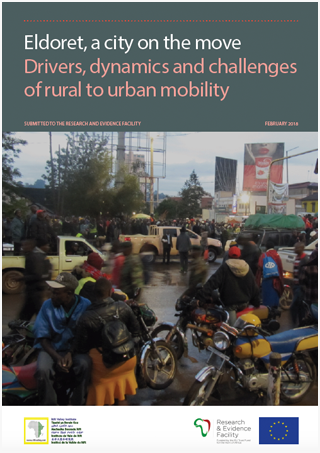
The Rift Valley Institute’s Rural to urban mobility project aims to better understand the dynamics of rural to urban migration and the ways in which this phenomenon impacts the social and infrastructural fabric of cities in East Africa. It is conducted…
RVI publishes books, research reports, research papers, briefings and meeting reports in a range of formats. Publications cover policy, research, arts, culture and local knowledge in the countries of eastern and central Africa. Research publications—books, reports and papers—are peer-reviewed. Some RVI publications are also available in French and/or Arabic.
The RVI is a signatory of the Budapest Open Access Initiative (2001); all publications are free for download in PDF format under Creative Commons licences. The views expressed in books and reports published by the RVI are those of the authors, not the Institute.
SEARCH
PUBLICATION TYPE
LANGUAGE
REGION
COUNTRY
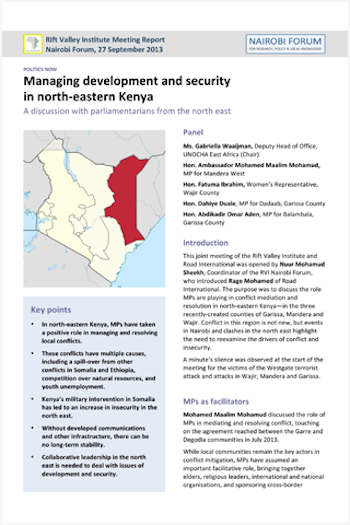
Key points In north-eastern Kenya, MPs have taken a positive role in managing and resolving local conflicts. These conflicts have multiple causes, including a spill-over from other conflicts in Somalia and Ethiopia, competition over natural resources, and youth unemployment….
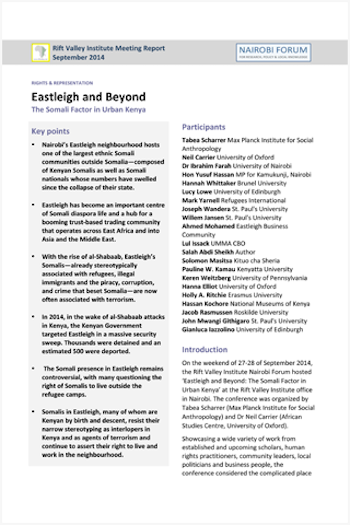
Key points Nairobi’s Eastleigh neighbourhood hosts one of the largest ethnic Somali communities outside Somalia—composed of Kenyan Somalis as well as Somali nationals whose numbers have swelled since the collapse of their state. Eastleigh has become an important centre…
In September 2014, a conflict erupted between South Sudanese and Ugandans in the borderlands of Kajokeji County, South Sudan and Moyo District, Uganda. Several people were killed, many more injured and thousands displaced. In Dividing Communities in South Sudan and…
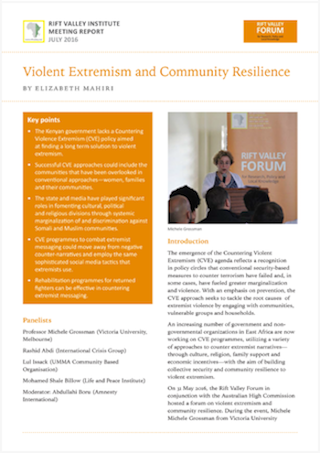
By Liz Mahiri Key points Panelists Professor Michele Grossman (Victoria University, Melbourne) Rashid Abdi (International Crisis Group) Lul Issack (UMMA Community Based Organisation) Mohamed Shale Billow (Life and Peace Institute) Moderator: Abdullahi Boru (Amnesty International) Introduction The emergence…
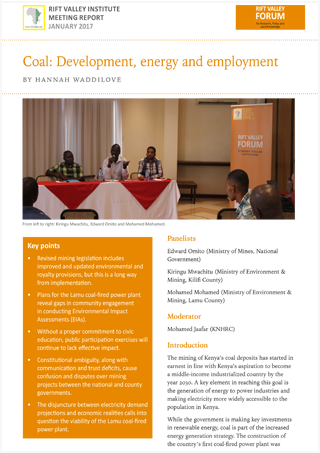
The mining of Kenya’s coal deposits has started in earnest in line with Kenya’s aspiration to become a middle-income industrialized country by the year 2030. A key element in reaching this goal is the generation of energy to power…
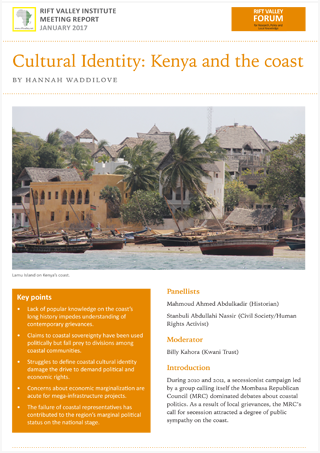
During 2010 and 2011, a secessionist campaign led by a group calling itself the Mombasa Republican Council (MRC) dominated debates about coastal politics. As a result of local grievances, the MRC’s call for secession attracted a degree of public…
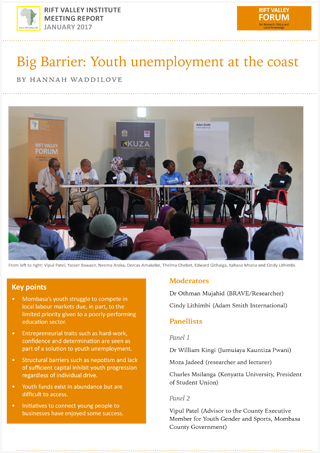
In Kenya, 80 per cent of the unemployed are believed to be below the age of 35. The rate of unemployment in Mombasa, Kenya’s second largest city and home to the region’s largest port, is estimated to be 44…
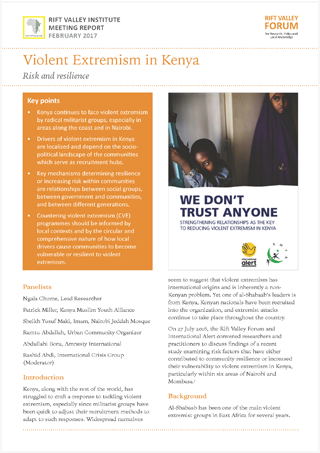
Kenya, along with the rest of the world, has struggled to craft a response to tackling violent extremism, especially since militarist groups have been quick to adjust their recruitment methods to adapt to such responses. Widespread narratives seem to…
Kenya’s 2010 Constitution introduced a quota system designed to increase the representation of women in elective and appointive bodies of government. Article 27(8)—known as the Gender Principle—states that ‘not more than two thirds of the members of elective bodies…
Recent Publications

Commodification and Conflict in the Horn of Africa Borderlands
April 1, 2026
This report synthesizes findings from the Rift Valley Institute’s X-Border Local Research Network (2019–2025). In the surveyed studies, 25 leading local and international area specialists conducted extensive qualitative fieldwork across borderlands in South Sudan, Sudan, Ethiopia, Kenya and the Somali

Peace and Instability: Tigray since the Pretoria Agreement
March 26, 2026
CONFLICT TRENDS ANALYSIS / MARCH 2026 Summary THE ETHIOPIA PEACE RESEARCH FACILITY This conflict trends analysis was produced by the Ethiopia Peace Research Facility (PRF). The PRF is an independent facility combining timely analysis on peace and conflict from Ethiopian

Political Economy of Cash and Markets in Sudan
February 27, 2026
The research provides a snapshot of the war in Sudan in the period from February to April 2025. However, the war is dynamic, with political alliances and territorial control changing. The April 2023 conflict between the Sudan Armed Forces (SAF)