In 1972, the rate of literacy in the Republic of Somalia was estimated to be 5.40 per cent of the total population. Soon afterwards in 1974 the Siyad Barre government launched ‘The Somalia Rural Literacy Campaign’ – an ambitious campaign…
RVI publishes books, research reports, research papers, briefings and meeting reports in a range of formats. Publications cover policy, research, arts, culture and local knowledge in the countries of eastern and central Africa. Research publications—books, reports and papers—are peer-reviewed. Some RVI publications are also available in French and/or Arabic.
The RVI is a signatory of the Budapest Open Access Initiative (2001); all publications are free for download in PDF format under Creative Commons licences. The views expressed in books and reports published by the RVI are those of the authors, not the Institute.
SEARCH
PUBLICATION TYPE
LANGUAGE
REGION
COUNTRY
This briefing considers the changing political situation in Sudan with a particular focus on the future of the Juba Peace Agreement ( JPA). It explores how the relationship between two key factions in the conflict has complicated the ongoing discussions…
This is the first paper in a series considering the future of Sudan’s Juba Peace Agreement (JPA) and peace-making after the fall of Omar al-Bashir in 2019. It was commissioned by the Rift Valley Institute for the UK government’s…
The unresolved status of Mogadishu is one of the key outstanding issues in Somalia’s political settlement. Since 2012, Somalia has made progress in clarifying its federal model through the establishment of Federal Member States (FMS) and efforts – albeit…
Somalia first formally adopted a federal model in 2004 with the establishment of the Transitional Federal Charter. Since then, it has been deepened and clarified with the adoption of the Provisional Federal Constitution in 2012 and the subsequent formation…
Soomaaliya ayaa markii ugu horreysay si rasmi ah u qaadatay hannaanka federaalka sannadkii 2004-tii markii la sameeyay Axdiga Federaalka Kumeelgaarka. Tan iyo markaas, dhidibada ayaa loo aasay iyadoo la qeexay markii la meel mariyay Dastuurka Federaalka Kumeelgaarka ah ee…
Somalia formally adopted a federal system in 2004 with the establishment of the Transitional Federal Government. This model became more established in 2012 with the ratification of the Provisional Federal Constitution (PFC), which clarified many critical areas of Somalia’s…
Soomaaliya waxa ay qaadatay nidaamka federaalka sanadii 2004 markaasoo la dhisay dowlad kumeelgaar ah. Nidaamkan ayaa noqday mid asaaskiisa la adkeeyay sannadkii 2012 kadib markii la ansixiyay Dastuurka Federaalka Kumeelgaarka, kaasoo caddeeyay meelo badan oo xasaasi ah oo ku…
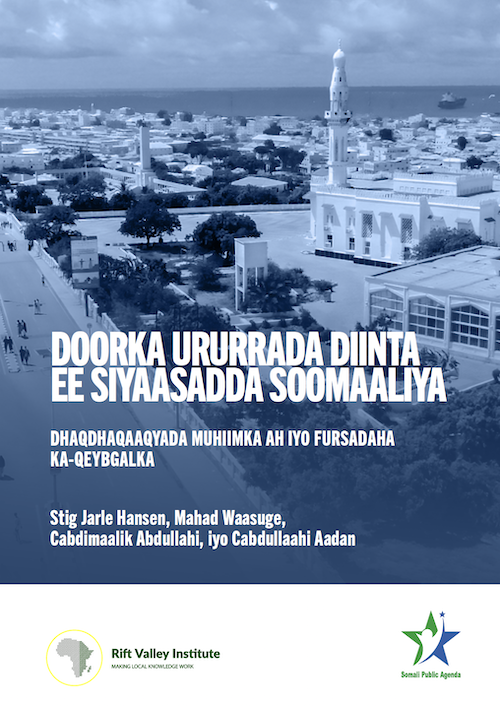
Ururrada diinta ayaa door muhiim ah ku leh siyaasadda Soomaaliya. Tan iyo burburkii qarankii Soomaaliya 1991-kii, waxay sidoo kale muujiyeen adkeysi xooggan iyadoo jilayaal badan oo oo kale ay soo ifbaxeen si degdeg ahna saaxadda uga baxeen. Tani waxay…
Over the past decade, there have been several important gains made with Somalia’s state-building process, notably the establishment of a Federal Government following the endorsement of the Provisional Constitution in 2012. This was followed by the formation of Federal…
Recent Publications

State Capture in Africa: How elite networks undermine democracy, development and security
June 24, 2026
Key points State capture has been increasingly recognized as a major governance challenge due to the way it helps to drive many of the most pressing problems facing contemporary states, including democratic erosion, corruption, economic exclusion, insecurity and declining trust

The New Geopolitics of Eastern Africa
June 17, 2026
On 20 May, the British Institute of Eastern Africa (BIEA), Chatham House, and the Rift Valley Institute (RVI) convened a group of experts to discuss the ‘The New Geopolitics of Eastern Africa’. The closed-door roundtable considered the ongoing transformation of

Commodification and Conflict in the Horn of Africa Borderlands
April 1, 2026
This report synthesizes findings from the Rift Valley Institute’s X-Border Local Research Network (2019–2025). In the surveyed studies, 25 leading local and international area specialists conducted extensive qualitative fieldwork across borderlands in South Sudan, Sudan, Ethiopia, Kenya and the Somali