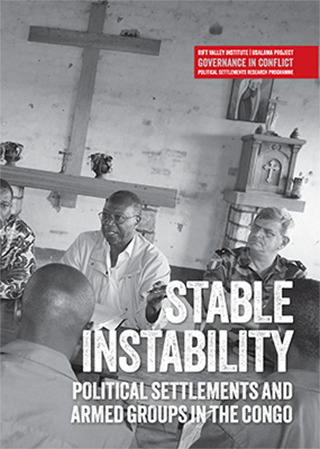
Dans l’est de la République démocratique du Congo (RDC), les litiges fonciers sont considérés à la fois comme une source majeure et un facteur important de conflit. Au fil du temps, les chercheurs et les praticiens ont identifié plusieurs…
RVI publishes books, research reports, research papers, briefings and meeting reports in a range of formats. Publications cover policy, research, arts, culture and local knowledge in the countries of eastern and central Africa. Research publications—books, reports and papers—are peer-reviewed. Some RVI publications are also available in French and/or Arabic.
The RVI is a signatory of the Budapest Open Access Initiative (2001); all publications are free for download in PDF format under Creative Commons licences. The views expressed in books and reports published by the RVI are those of the authors, not the Institute.
SEARCH
PUBLICATION TYPE
LANGUAGE
REGION
COUNTRY
The Rift Valley Institute’s study on the impact of war on Somali men looks into a previously under-researched set of questions: What are the enduring effects of more than two decades of war and violent conflict on Somali men…
This report is a record of a Forum event held on 5 November, before the 13 November 2017 election day. Election day itself was largely peaceful, and the international observer mission reported only minor irregularities on election day, including…
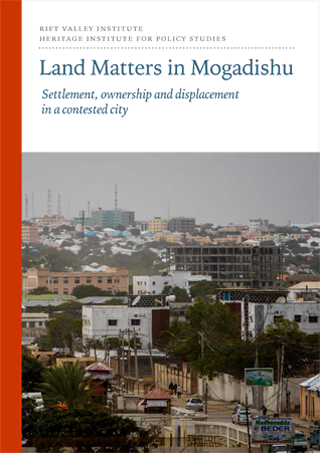
Mogadishu has for more than two decades been one of the most highly contested cities in the world. Since the collapse of President Siyad Barre’s government in early 1991, it has been the object of both military and political…
‘This is a vivid account—one of the best I’ve come across—of what it is to be a Somali migrant in pursuit of a safer future elsewhere, away from the precarious life in the Somali Peninsula. I’ve found it a…
On 6 September 2017, the Ministry of Humanitarian Affairs and Disaster Management of the Federal Government of Somalia, in collaboration with the UK Department for International Development (DFID), the Office of the Deputy Representative of the UN Secretary General,…
Kenya’s 2010 Constitution introduced a quota system designed to increase the representation of women in elective and appointive bodies of government. Article 27(8)—known as the Gender Principle—states that ‘not more than two thirds of the members of elective bodies…
- By Michel Thill, Robert Njangala, Josaphat Musamba
- Download
Depuis les années 1990, le concept de Réforme du secteur de la sécurité (RSS) fait partie intégrante des programmes de reconstruction post-conflit, de rétablissement de l’autorité de l’État et de développement. En République démocratique du Congo (RDC), la réforme de…
South Sudan’s political culture, including its current civil war, is international. This is due to the country’s history of mass migration and displacement, particularly during the last two civil wars from the early 1960s. By the end of the…
Security sector reform has been a central component of post-conflict reconstruction and development programmes, and the restoration of state authority since the 1990s. However, these reforms have rarely been successful in the long run. In the DRC, police reform has…
Recent Publications

Aid and Conflict Sensitivity in Contemporary Ethiopia
November 17, 2025
This study assesses conflict sensitivity practices among humanitarian, development and peacebuilding (HDP) actors in Ethiopia. It seeks to raise awareness and foster a deeper understanding of the evolving aid landscape in the country while analysing the challenges that affect conflict-sensitive

Enhancing the Role of Borderland Communities in Ethiopia’s Foreign Policy
October 15, 2025
Ethiopia’s borderland communities (BLCs) have historically influenced the country’s relations with its neighbours. These peripheral regions often serve as hubs for cross-border trade, repositories of natural resources and, at times, flashpoints of conflict. Surrounded by six neighbouring countries – Djibouti,

Women in the Social Sciences and Humanities in Ethiopia: The case of Addis Ababa University
October 10, 2025
This preliminary assessment is part of the launch exercise of the Ethiopian Women Researchers’ Network (EWNET). Focusing on Addis Ababa University as a pioneering higher institution in the country, the study looks into the status of women within these disciplines