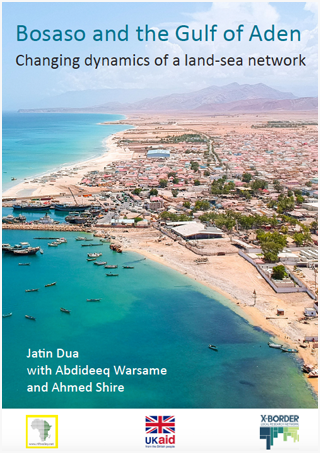
Bosaso and the Gulf of Aden: Changing dynamics of a land-sea network is the second report in a series looking at the relationship between modern-day Puntland, a semi-autonomous region of north-east Somalia, Yemen and the wider Gulf region. It…
RVI publishes books, research reports, research papers, briefings and meeting reports in a range of formats. Publications cover policy, research, arts, culture and local knowledge in the countries of eastern and central Africa. Research publications—books, reports and papers—are peer-reviewed. Some RVI publications are also available in French and/or Arabic.
The RVI is a signatory of the Budapest Open Access Initiative (2001); all publications are free for download in PDF format under Creative Commons licences. The views expressed in books and reports published by the RVI are those of the authors, not the Institute.
SEARCH
PUBLICATION TYPE
LANGUAGE
REGION
COUNTRY
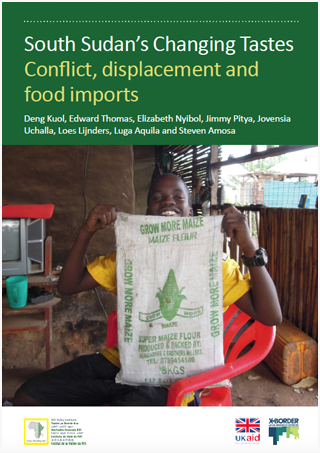
South Sudan’s long wars have forced millions of people to leave their own homes, farms and pastures and move to unfamiliar new areas of the countryside, to refugee camps and cities. In the process, they have changed the way…
The third update from RVI’s Somali Dialogue Platform project examines political dynamics around elections in Somalia and considerations for advancing dialogue to reach consensus. The update is a product of the Somali Dialogue Platform, which supports Somalis to achieve consensus on…
Displaced Tastes is a collaborative research project run by the Rift Valley Institute (RVI) and the Catholic University of South Sudan (CUofSS) as part of the X-Border Local Research Network. The project examines how experiences of conflict, regional displacement…
Despite progress in some significant areas, Somalia’s politics continue to be shaped by stark differences between key political players. This is most evident in the ongoing disagreement around one-person-onevote (OPOV) elections, the framework for which is timetabled to be…
In early 2019, the Federal Government of Somalia announced that it had raised the government budget to USD 300 million, and by August 2019 had recorded public expenditure of USD 171 million. This enabled the IMF to announce on…
Focusing on South Sudan’s borderland with Sudan, in Northern Bahr el-Ghazal, it is clear that the national response to the virus, particularly the border shutdown, has rapidly become a new factor in Sudan and South Sudan’s cross-border political economy….
The number of Coronavirus (COVID-19) infections and related deaths is rapidly increasing in Somalia. However, at present it is the secondary, primarily economic, effects of the pandemic that are being most keenly felt. The impact on the khat trade…
South Sudan has, up to the time of writing, avoided the worst effects of the global coronavirus pandemic. However, as the disease spreads further through the African continent, South Sudan—and other countries in the Greater Horn of Africa region—need…
The coronavirus pandemic (COVID-19) of 2020 is likely to have profound effects on stressed food systems in already hungry countries. Even before South Sudan reported its first COVID-19 case at the beginning of April, media reports indicated that the…
Recent Publications

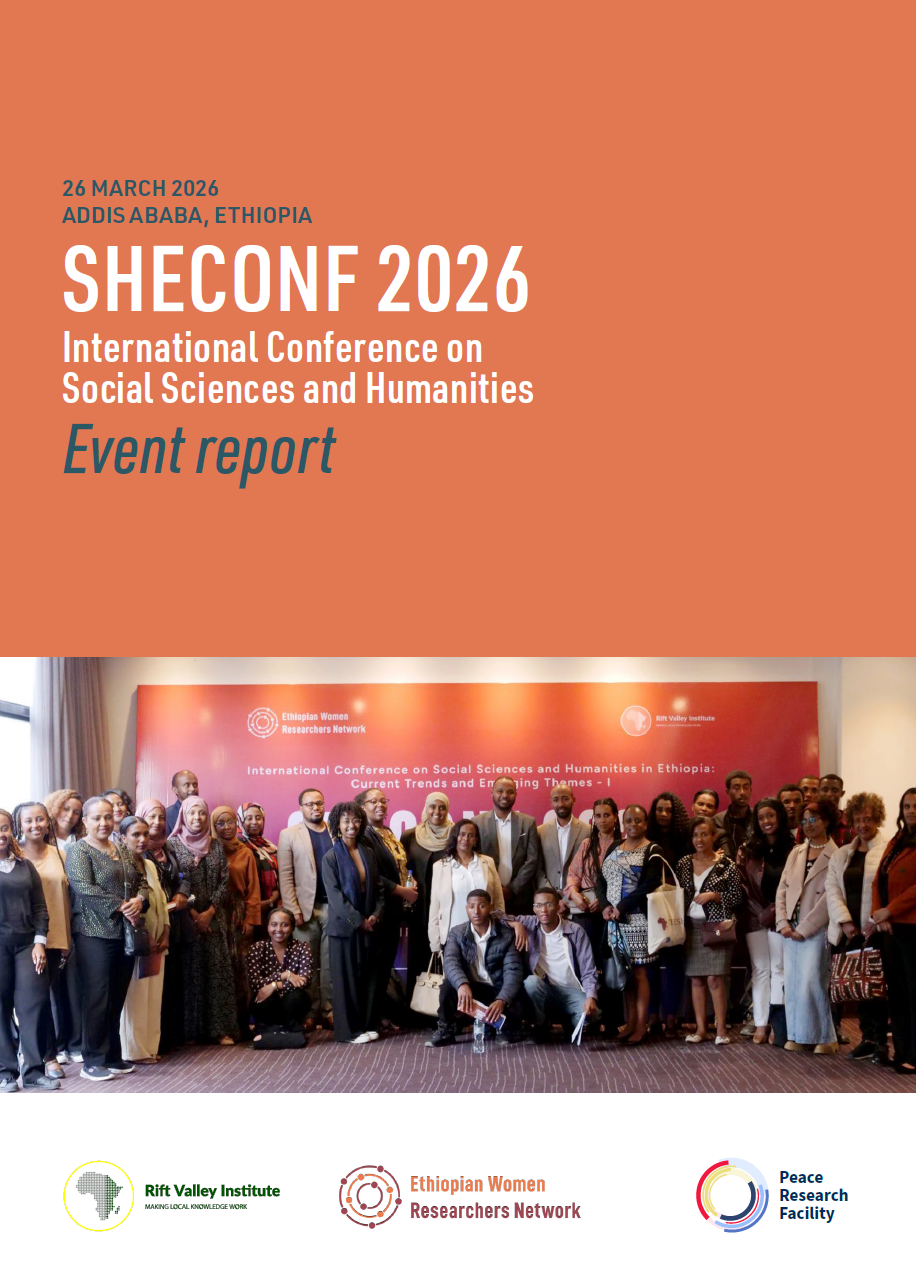
SHECONF 2026: International Conference on Social Sciences and Humanities
July 9, 2026
Event report On 26 March 2026, researchers, practitioners and academics gathered in Addis Ababa for SHECONF 2026, an International Conference on Social Sciences and Humanities in Ethiopia, the first of its kind convened by the Ethiopian Women Researchers Network (EWNET).
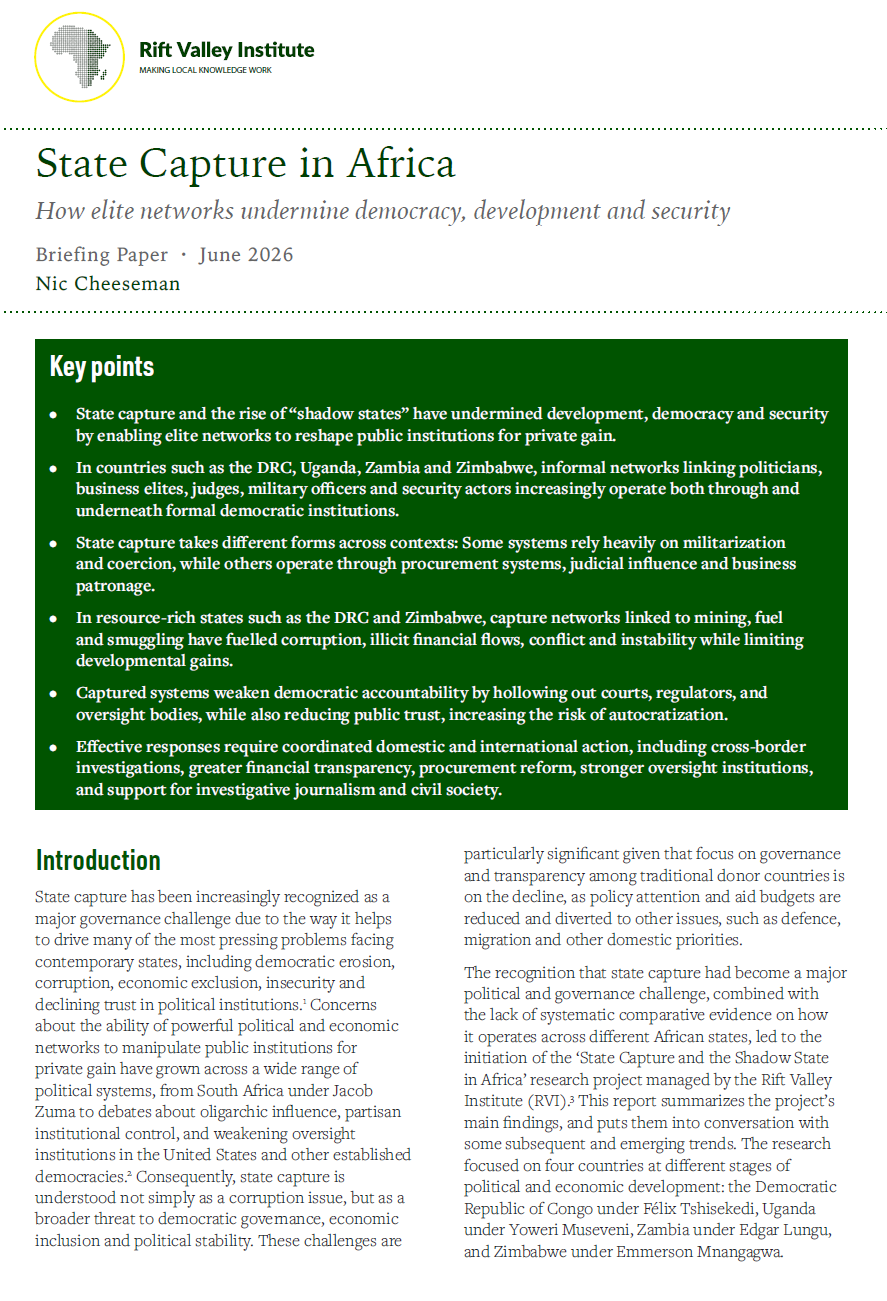
State Capture in Africa: How elite networks undermine democracy, development and security
June 24, 2026
Key points State capture has been increasingly recognized as a major governance challenge due to the way it helps to drive many of the most pressing problems facing contemporary states, including democratic erosion, corruption, economic exclusion, insecurity and declining trust

The New Geopolitics of Eastern Africa
June 17, 2026
On 20 May, the British Institute of Eastern Africa (BIEA), Chatham House, and the Rift Valley Institute (RVI) convened a group of experts to discuss the ‘The New Geopolitics of Eastern Africa’. The closed-door roundtable considered the ongoing transformation of