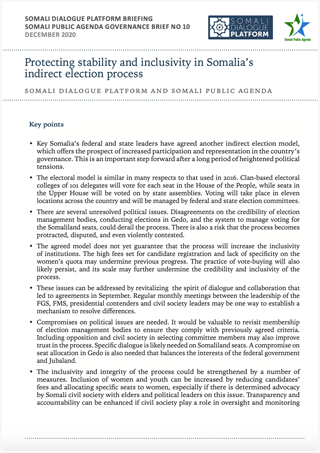
On 17 September, the leaders of the Federal Government of Somalia (FGS) and all five Federal Member States (FMS) agreed on an indirect electoral model for the country’s upcoming polls. Building on a series of discussions in Dhusamareb in…
RVI publishes books, research reports, research papers, briefings and meeting reports in a range of formats. Publications cover policy, research, arts, culture and local knowledge in the countries of eastern and central Africa. Research publications—books, reports and papers—are peer-reviewed. Some RVI publications are also available in French and/or Arabic.
The RVI is a signatory of the Budapest Open Access Initiative (2001); all publications are free for download in PDF format under Creative Commons licences. The views expressed in books and reports published by the RVI are those of the authors, not the Institute.
SEARCH
PUBLICATION TYPE
LANGUAGE
REGION
COUNTRY
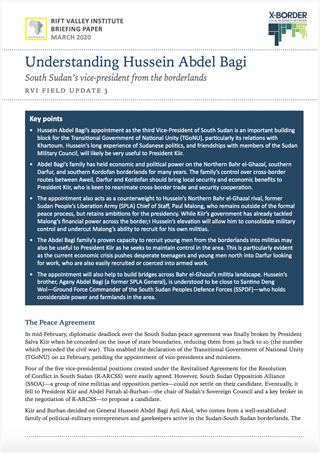
Key points • Hussein Abdel Bagi’s appointment as the third Vice-President of South Sudan is an important building block for the Transitional Government of National Unity (TGoNU), particularly its relations with Khartoum. Hussein’s long experience of Sudanese politics, and…
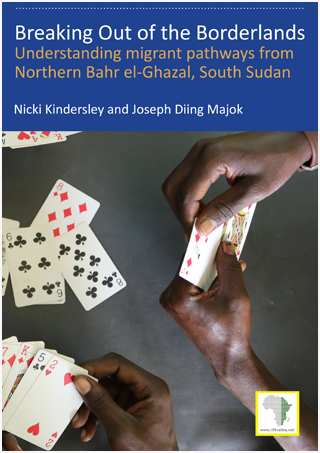
Breaking Out of the Borderlands is the second report by Dr Nicki Kindersley and Joseph Diing Majok on South Sudan’s changing borderland economy. The first report in the series—Monetized Livelihoods and militarized Labour in South Sudan’s Borderlands—described the protracted…
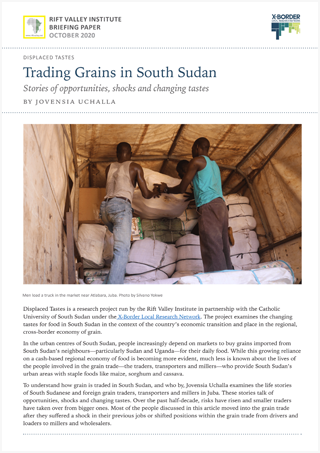
Displaced Tastes is a research project run by the Rift Valley Institute in partnership with the Catholic University of South Sudan under the X-Border Local Research Network. The project examines the changing tastes for food in South Sudan in…
The Somaliland Peace and Development Journal (SPDJ) is an annual peer-reviewed academic journal from the Institute for Peace and Conflict Studies, University of Hargeysa. The Journal began during a collaboration between RVI, the University of Hargeysa and Puntland State University…
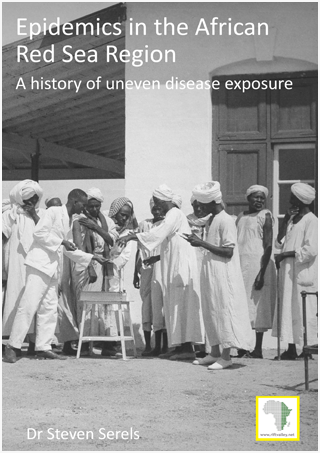
Summary The sustained movement of people, goods and ideas across the African Red Sea Region has been and continues to be so intense that it binds together communities throughout the region in a unified multifaceted socio-economic system that transcends…
This briefing summarizes findings from the mid-point of the Community Approaches to Epidemic Management in South Sudan research project. The project is run by the Rift Valley Institute (RVI) and funded by the UK Foreign Commonwealth and Development Office…
In South Sudan, access to energy is crucial for survival, recovery and resilience in what is an extremely challenging economic and security environment. Fuelling Poverty—a product of the Energy on the Move project—examines the challenges of meeting everyday energy…
Codka kalsooni kala noqoshada ee 25-kii Luulyo lagu riday Ra’iisul Wasaarihii Soomaaliya wuxuu horseeday kalsooni darro siyaasadeed oo kasoo cusboonaatay Soomaaliya; dhaqanka siyaasadeed ayaa ah in uu Madaxweynaha soddon maalmood kusoo magacaabo Ra’iisul Wasaaraha xiga, kaasoo isaguna magacaabi doona…
The vote of no confidence on 25 July in the Prime Minister has led to renewed political uncertainty in Somalia; the constitution gives the President thirty days from this date to appoint the next Prime Minister, who will in…
Recent Publications

The Political Economy of Coffee in the Sidama–Gedeo–Guji Belt, Southern Ethiopia
September 4, 2026
This report is part of a wider research project on the political economy of coffee in Ethiopia in the context of the political transition since 2018. It focuses on the Sidama–Gedeo–Guji coffee belt in southern Ethiopia, aiming to understand the

SHECONF 2026: International Conference on Social Sciences and Humanities
July 9, 2026
Event report On 26 March 2026, researchers, practitioners and academics gathered in Addis Ababa for SHECONF 2026, an International Conference on Social Sciences and Humanities in Ethiopia, the first of its kind convened by the Ethiopian Women Researchers Network (EWNET).

State Capture in Africa: How elite networks undermine democracy, development and security
June 24, 2026
Key points State capture has been increasingly recognized as a major governance challenge due to the way it helps to drive many of the most pressing problems facing contemporary states, including democratic erosion, corruption, economic exclusion, insecurity and declining trust