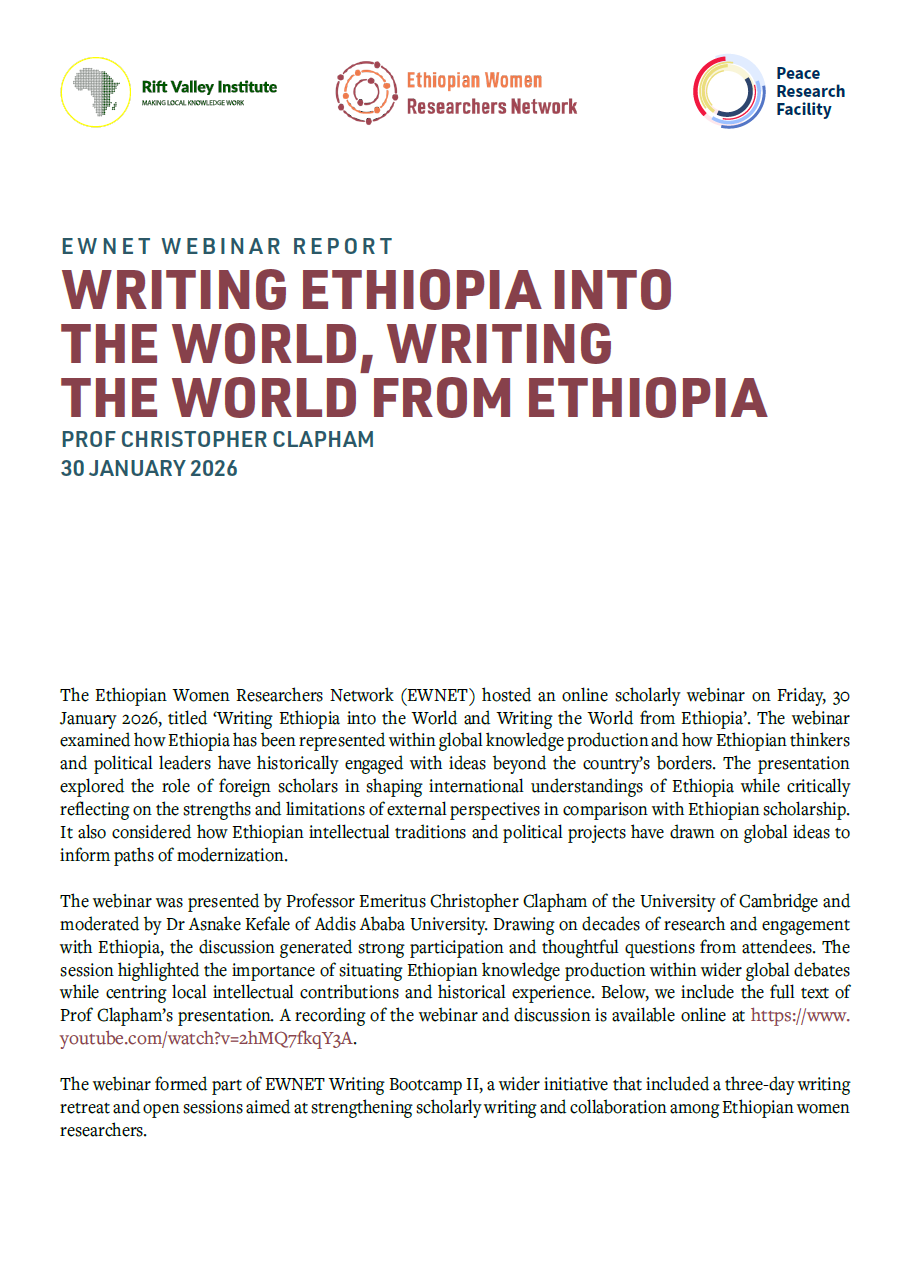
The devastating war in Sudan between the Sudan Armed Forces (SAF) and Rapid Support Forces (RSF) has also had a profound impact on the country’s neighbours, particularly South Sudan. This is especially the case for areas that border Sudan,…
RVI publishes books, research reports, research papers, briefings and meeting reports in a range of formats. Publications cover policy, research, arts, culture and local knowledge in the countries of eastern and central Africa. Research publications—books, reports and papers—are peer-reviewed. Some RVI publications are also available in French and/or Arabic.
The RVI is a signatory of the Budapest Open Access Initiative (2001); all publications are free for download in PDF format under Creative Commons licences. The views expressed in books and reports published by the RVI are those of the authors, not the Institute.
SEARCH
PUBLICATION TYPE
LANGUAGE
REGION
COUNTRY
SUMMARY This report explores the political economy of checkpoints in Somalia: What drives their formation? What impacts do they have on trade, society and political projects? To explore these factors, new empirical data is presented on the distribution and…
THE POLITICAL ECONOMY OF CHECKPOINTS ALONG THE BAIDOA CORRIDOR SUMMARY • The Baidoa corridor is a transport and trade route that connects Somalia’s coastal capital, Mogadishu, to Kenya via the border towns of Bula Hawa and Dollow, respectively. As…
THE POLITICAL ECONOMY OF CHECKPOINTS ALONG SOMALIA’S GARISSA CORRIDOR SUMMARY • The Garissa corridor is an essential artery for trade and exchange between Kismayo in Somalia’s Jubaland state, and the Kenyan city of Garissa. Checkpoints along this route were…
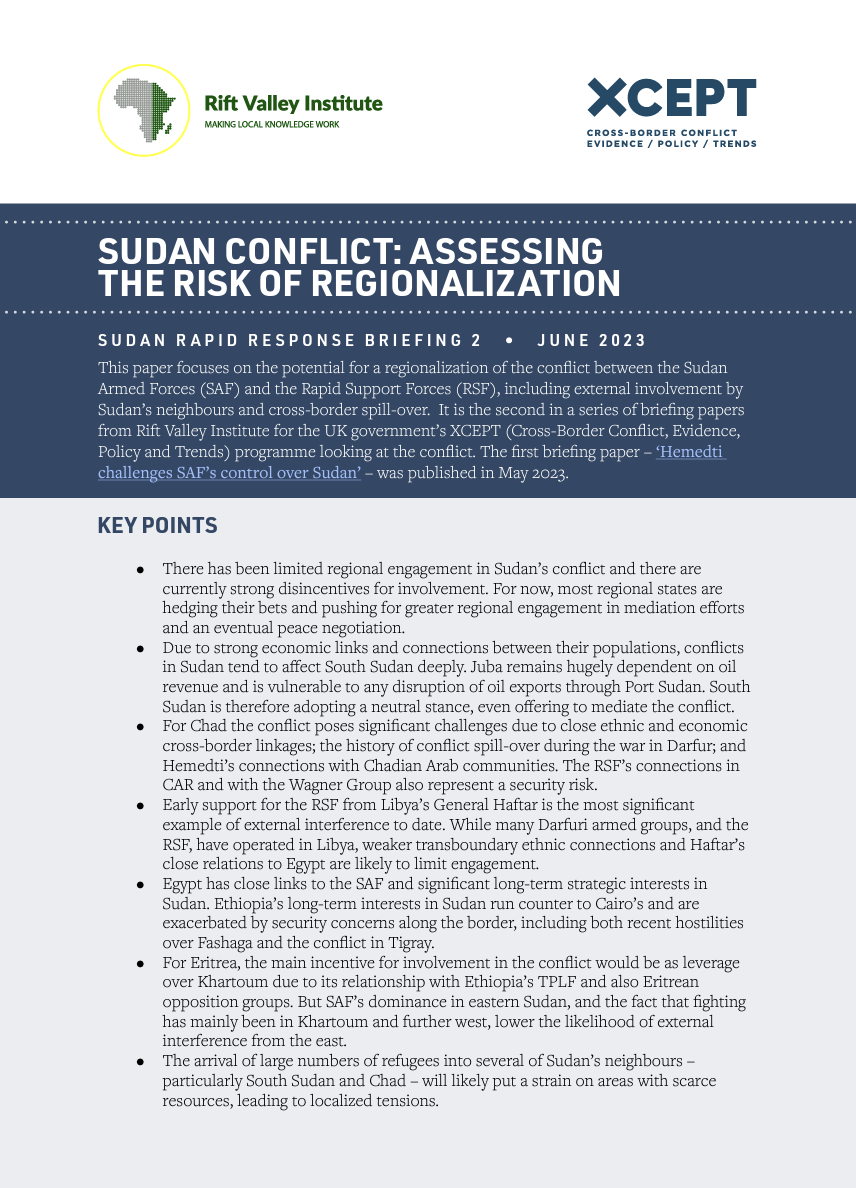
This paper focuses on the potential for a regionalization of the conflict between the Sudan Armed Forces (SAF) and the Rapid Support Forces (RSF), including external involvement by Sudan’s neighbours and cross-border spill-over. It is the second in a…
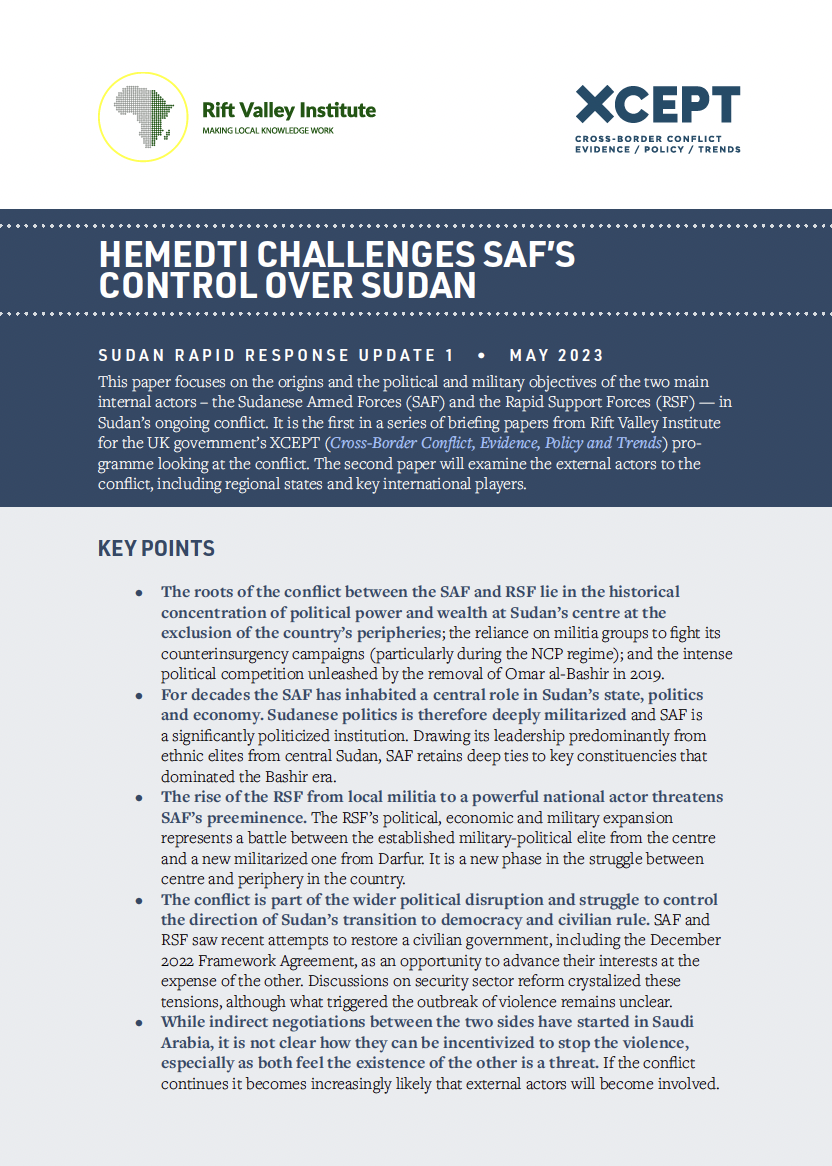
This paper focuses on the origins and the political and military objectives of the two main internal actors – the Sudanese Armed Forces (SAF) and the Rapid Support Forces (RSF) — in Sudan’s ongoing conflict. It is the first…
- By Mustafe M. Abdi
- Download
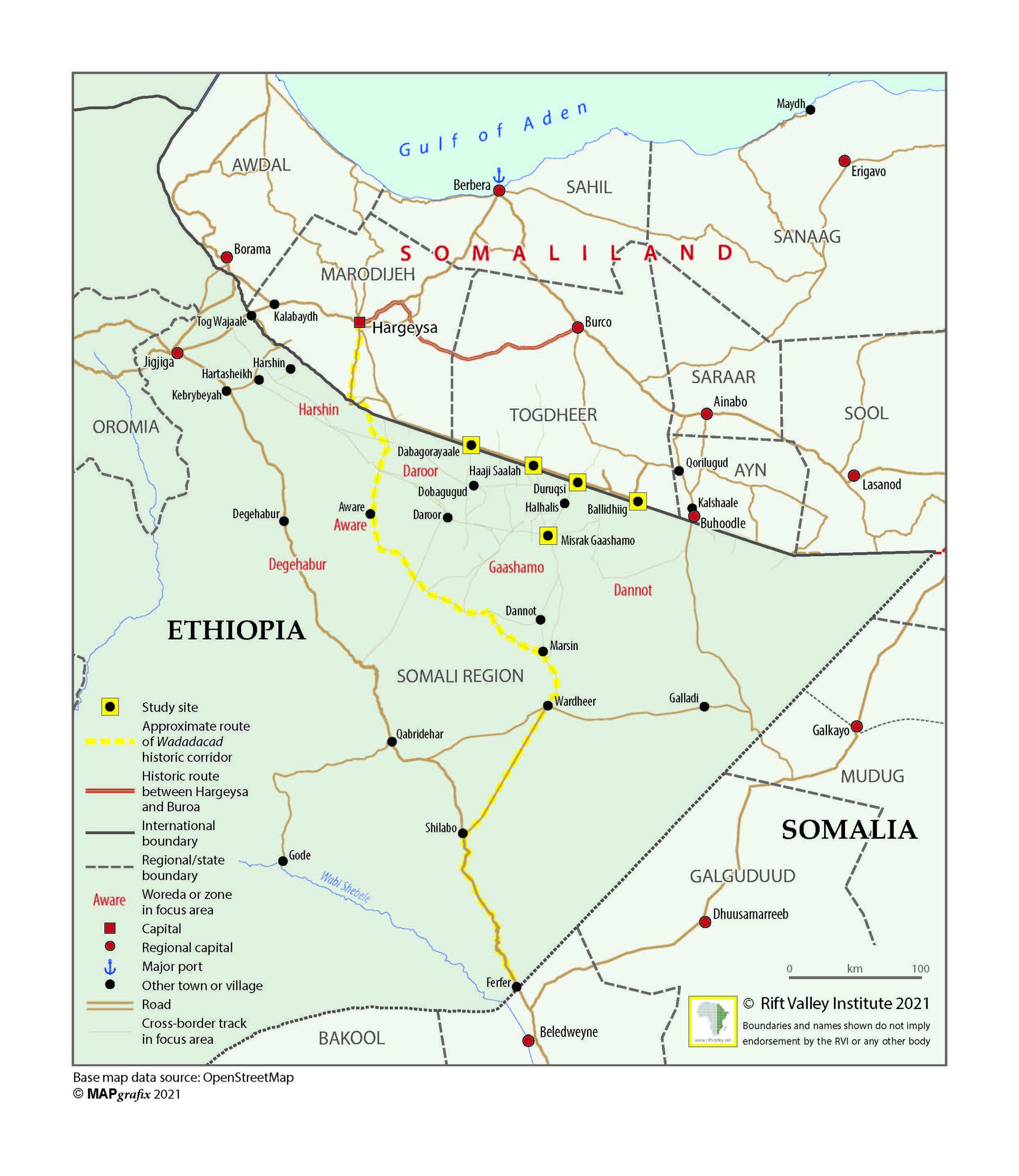
The current conflict over the contested city of Lasanod has the potential to expand into a crisis affecting several of the Somali-speaking territories. This blog – building on research the author conducted in 2021 – looks at the conflict…
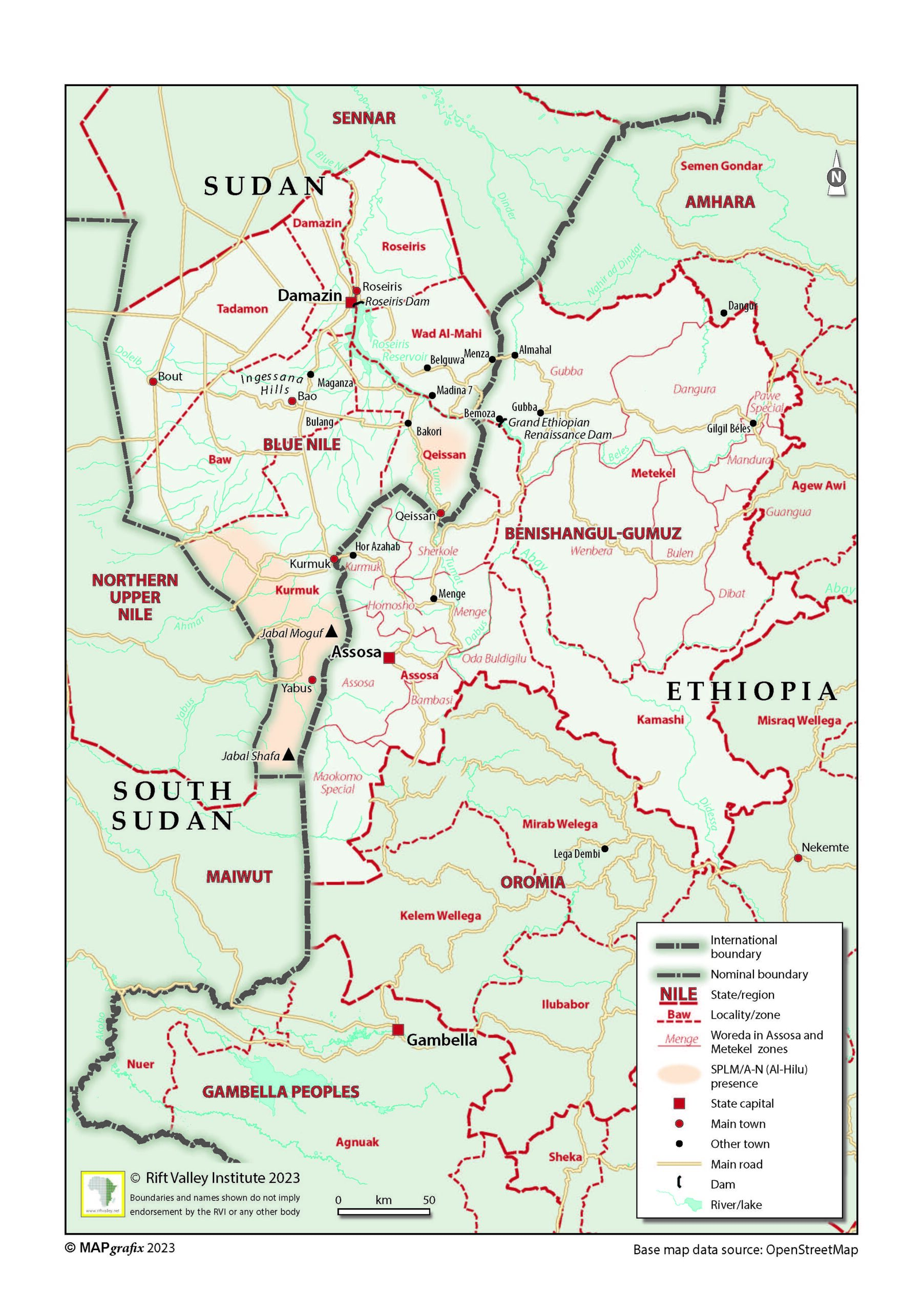
Summary • Historically, the people living along the Blue Nile – Benishangul-Gumuz borderlands in what is now Sudan and Ethiopia have been politically and socially marginalized within their respective political entities. As such they have sought ways to address…
- Download
Armed opposition groups in Sudan and Ethiopia’s border regions have a history of leveraging support, often military, from their neighbours to aid their political aspirations at home. These dynamics have fluctuated in line with broader changes in the region…
- By Abdirahman Edle
- Download
The site of recurrent famines and humanitarian crises, Somalia’s Bay and Bakool regions were once considered the country’s breadbasket. In this blog, researcher and former development worker Abdirahman Edle explains how, over the past two decades, the region has…
Recent Publications

Writing Ethiopia into the World, Writing the World from Ethiopia
October 7, 2026
The Ethiopian Women Researchers Network (EWNET) hosted an online scholarly webinar on Friday, 30 January 2026, titled ‘Writing Ethiopia into the World and Writing the World from Ethiopia’. The webinar examined how Ethiopia has been represented within global knowledge production
The Political Economy of Coffee in the Kaffa–Bench-Sheko–Sheka Belt, Southwest Ethiopia Region
October 6, 2026
This study provides a critical political economy analysis of the coffee sector in the Kaffa–Bench-Sheko–Sheka belt in Southwest Ethiopia Peoples’ Regional State, the genetic and cultural heartland of Arabica coffee (Coffea arabica). Based on 47 key respondent interviews, the study
The Political Economy of Coffee in the Jimma–Ilu Aba Bora–Buno Bedele Belt, Oromia Region
October 5, 2026
The findings of this study reveal a number of critical insights about the political economy of coffee in the Jimma–Ilu Aba Bora–Buno Bedele coffee belt. The coffee economy is shaped by a small number of influential actors, including state institutions,