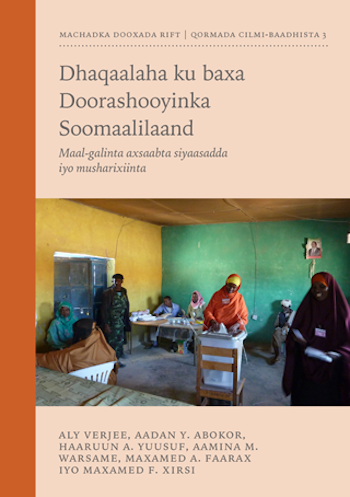
‘An enlightening exposé of the motives and societal pressures that spur irregular migration, in this particular case, from Somaliland and Puntland. This study could not be timelier given that people smugglers and migrant traffickers have proven themselves to be…
RVI publishes books, research reports, research papers, briefings and meeting reports in a range of formats. Publications cover policy, research, arts, culture and local knowledge in the countries of eastern and central Africa. Research publications—books, reports and papers—are peer-reviewed. Some RVI publications are also available in French and/or Arabic.
The RVI is a signatory of the Budapest Open Access Initiative (2001); all publications are free for download in PDF format under Creative Commons licences. The views expressed in books and reports published by the RVI are those of the authors, not the Institute.
SEARCH
PUBLICATION TYPE
LANGUAGE
REGION
COUNTRY
In Kenya, 80 per cent of the unemployed are believed to be below the age of 35. The rate of unemployment in Mombasa, Kenya’s second largest city and home to the region’s largest port, is estimated to be 44…
For more than a year now, two decades of relative social and political order in Ethiopia has been disrupted by unprecedented protest and unrest. Long-standing grievances erupted in November 2015, only six months after the ruling Ethiopia Peoples Revolutionary…
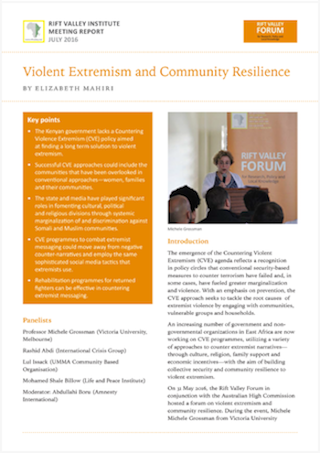
Kenya, along with the rest of the world, has struggled to craft a response to tackling violent extremism, especially since militarist groups have been quick to adjust their recruitment methods to adapt to such responses. Widespread narratives seem to…
On 22 April 2016, the Rift Valley Forum hosted the launch of Saferworld’s report, Forging Jubaland, Community Perspectives on Federalism, Governance and Reconciliation. The creation of Jubaland state in 2013 and the controversial appointment of Sheikh Ahmed Mohamed Islam…
In early 2011, the scale of famine affecting the Horn of Africa was only just beginning to receive international attention, despite early warnings in the previous year. It was not until July that famine was formally declared. The famine…
In April 2015, protests erupted in Burundi when President Pierre Nkurunziza’s sought a third term in office. Protestors claimed this was contrary to the country’s constitution, but the constitutional court sided with Nkurunziza. After an attempted coup in May…
With the formation of a Transitional Government of National Unity (TGoNU) and the subsequent outbreak of violence in Juba in July 2016, the role of civil society in South Sudan is more vital than ever. Can a civil society,…
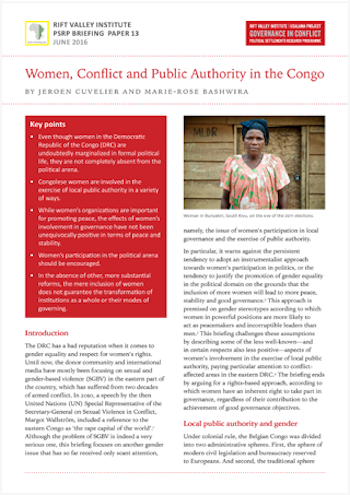
After more than two decades of ongoing violent conflict, armed groups—however fleeting their existence—have become an integral feature of the eastern Congo’s social-political order. They are not a temporary aberration in what is otherwise a normal society. They are…
In April 2016, seventeen chiefs from different parts of South Sudan gathered in Kuron Holy Trinity Peace Village, in Eastern Equatoria, to discuss the role of customary authority in governance—past and present—and their own contribution to peacemaking and a…
Recent Publications

EWNET Writes: Writing Workshop Session I
December 18, 2025
The Ethiopian Women Researchers Network (EWNET) inaugural writing workshop series aims to not only provide women researchers with uninterrupted time for their scholarly projects, but also build a supportive academic community. The first session, entitled ‘EWNET Writes: Writing Workshop Session

SSC-Khaatumo: Perspectives on the significance and implications of its formation
December 12, 2025
On 15 April 2025, during a visit to the city of Las Anod in Sool, Prime Minister Hassan Abdi Barre officially declared the federal government’s recognition of SSC-Khaatumo (SSC-K hereafter) as a federal member state, marking an important milestone in

Aid and Conflict Sensitivity in Contemporary Ethiopia
November 17, 2025
This study assesses conflict sensitivity practices among humanitarian, development and peacebuilding (HDP) actors in Ethiopia. It seeks to raise awareness and foster a deeper understanding of the evolving aid landscape in the country while analysing the challenges that affect conflict-sensitive