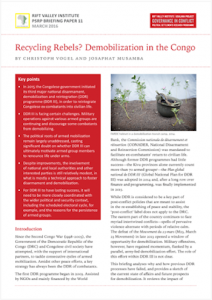
Since the Second Congo War (1998–2003), the Government of the Democratic Republic of the Congo (DRC) and Congolese civil society have attempted, with the support of international partners, to tackle consecutive cycles of armed mobilization. Amidst other peace efforts, a key strategy has always been the DDR of combatants. This briefing analyses why and how previous DDR processes have failed, and provides a sketch of the current state of affairs and future prospects for demobilization. It reviews the impact of CONADER and the potential of DDR III, focusing on the role of combatants, commanders and politicians. In particular, the briefing discusses incentives for armed groups to join demobilization programmes under conditions of high insecurity and distrust, as well as the relationship between demobilization and remobilization. The briefing argues that a holistic approach to DDR is needed, which would make it part of a genuine effort at social transformation and reform of the security sector, which in turn casts doubts on its feasibility within the current context of political competition and insecurity in the DRC.
Writing Ethiopia into the World, Writing the World from Ethiopia
The Ethiopian Women Researchers Network (EWNET) hosted an online scholarly webinar on Friday, 30 January 2026, titled ‘Writing Ethiopia into the World and Writing the