
The Big Barrier

In Kenya, 80 per cent of the unemployed are believed to be below the age of 35. The rate of unemployment in Mombasa, Kenya’s second largest city and home to the region’s largest port, is estimated to be 44 per cent. This raises concerns of how the Kenyan coast will be able to harness its […]
In conversation with Sir Mohinder Dhillon

On 27 January 2017, the Rift Valley Forum and the British Institute in Eastern Africa hosted the launch of My Camera, My Life. In his autobiography, Mohinder revisits his records of events that shaped his career as well as Kenya’s history and beyond. He documents Kenya’s independence heroes and his close relationship with top African […]
Between Community and the Police

Governments have been accused of using hard power approaches when dealing with violent extremism, to the detriment and of communication and trust between the law enforcement sector and community members. With the recognition that these approaches have failed, CVE actors are increasingly focusing on community-based approaches to counter extremist narratives. On 31 January 2017, the Rift […]
Hustling for Security: Managing plural security in Nairobi’s poor urban settlements
Home to two million people, Nairobi’s informal settlements host the city’s most vulnerable communities who lack access to virtually all publicly run services, especially security. In these settlements, multiple players have emerged to claim the role of security providers, and citizens must ‘hustle’ for security. On 17 June 2016, the Rift Valley Forum launched Hustling for […]
Dividing Communities in South Sudan and Northern Uganda
In September 2014, a conflict erupted between South Sudanese and Ugandans in the borderlands of Kajokeji County, South Sudan and Moyo District, Uganda. Several people were killed, many more injured and thousands displaced. In Dividing Communities in South Sudan and Northern Uganda, the authors argue that the boundary dispute is not simply the result of a […]
Violent Extremism and Community Resilience
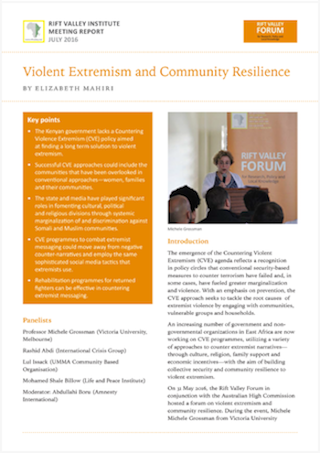
By Liz Mahiri Key points Panelists Professor Michele Grossman (Victoria University, Melbourne) Rashid Abdi (International Crisis Group) Lul Issack (UMMA Community Based Organisation) Mohamed Shale Billow (Life and Peace Institute) Moderator: Abdullahi Boru (Amnesty International) Introduction The emergence of the Countering Violent Extremism (CVE) agenda reflects a recognition in policy circles that conventional security-based […]
Coal: Development, energy and employment
The mining of Kenya’s coal deposits has started in earnest in line with Kenya’s aspiration to become a middle-income industrialized country by the year 2030. A key element in reaching this goal is the generation of energy to power industries and making electricity more widely accessible to the population in Kenya. While the government is […]
Cultural Identity: Kenya and the coast
During 2010 and 2011, a secessionist campaign led by a group calling itself the Mombasa Republican Council (MRC) dominated debates about coastal politics. As a result of local grievances, the MRC’s call for secession attracted a degree of public sympathy on the coast. Debates emerged that portrayed two contrasting images of Kenya: the inclusive nation […]
One slum, three upgrades

In 2004, the Kenyan government in collaboration with UN-HABITAT launched the Kenya Slum Upgrading Programme (KENSUP), which aims to improve the living conditions of about 60 per cent of the country’s urban population by 2020. Kibera, the largest informal settlement in the country, is a pilot project under this programme. Other major development projects in […]
Big Barrier: Youth unemployment at the coast
In Kenya, 80 per cent of the unemployed are believed to be below the age of 35. The rate of unemployment in Mombasa, Kenya’s second largest city and home to the region’s largest port, is estimated to be 44 per cent. The Kuza project’s definition of unemployment includes those earning less than KES 10,000 (USD […]