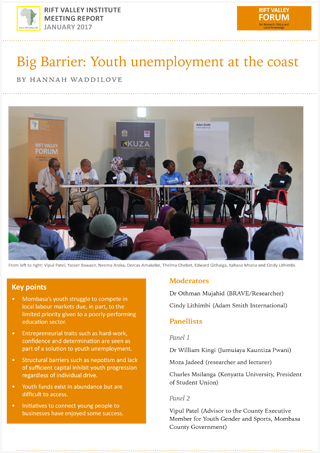
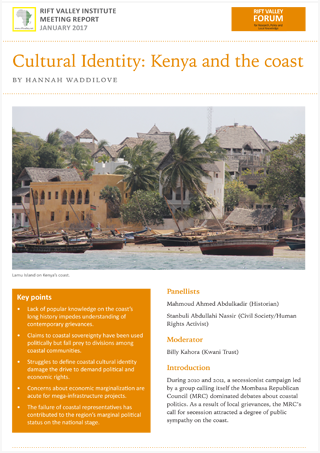
During 2010 and 2011, a secessionist campaign led by a group calling itself the Mombasa Republican Council (MRC) dominated debates about coastal politics. As a result of local grievances, the MRC’s call for secession attracted a degree of public…
RVI publishes books, research reports, research papers, briefings and meeting reports in a range of formats. Publications cover policy, research, arts, culture and local knowledge in the countries of eastern and central Africa. Research publications—books, reports and papers—are peer-reviewed. Some RVI publications are also available in French and/or Arabic.
The RVI is a signatory of the Budapest Open Access Initiative (2001); all publications are free for download in PDF format under Creative Commons licences. The views expressed in books and reports published by the RVI are those of the authors, not the Institute.
SEARCH
PUBLICATION TYPE
LANGUAGE
REGION
COUNTRY
In Kenya, 80 per cent of the unemployed are believed to be below the age of 35. The rate of unemployment in Mombasa, Kenya’s second largest city and home to the region’s largest port, is estimated to be 44…
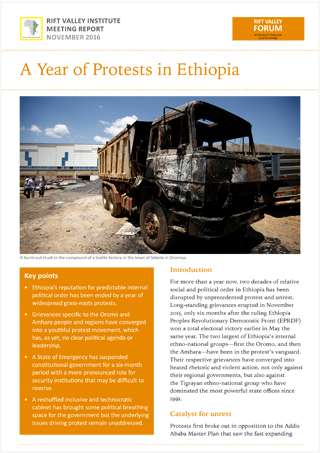
For more than a year now, two decades of relative social and political order in Ethiopia has been disrupted by unprecedented protest and unrest. Long-standing grievances erupted in November 2015, only six months after the ruling Ethiopia Peoples Revolutionary…
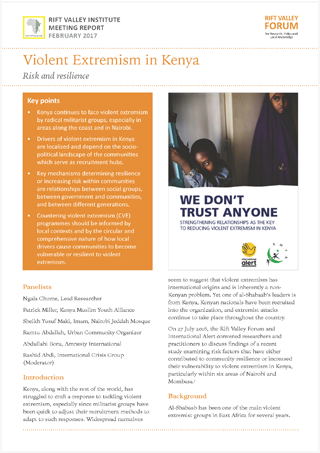
Kenya, along with the rest of the world, has struggled to craft a response to tackling violent extremism, especially since militarist groups have been quick to adjust their recruitment methods to adapt to such responses. Widespread narratives seem to…
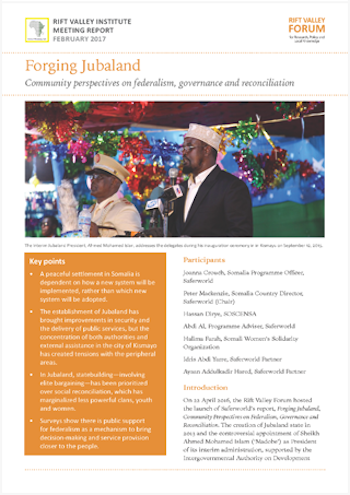
On 22 April 2016, the Rift Valley Forum hosted the launch of Saferworld’s report, Forging Jubaland, Community Perspectives on Federalism, Governance and Reconciliation. The creation of Jubaland state in 2013 and the controversial appointment of Sheikh Ahmed Mohamed Islam…
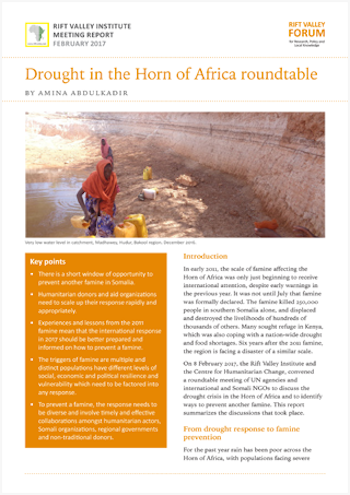
In early 2011, the scale of famine affecting the Horn of Africa was only just beginning to receive international attention, despite early warnings in the previous year. It was not until July that famine was formally declared. The famine…
This report is a record of a Forum event held on 5 November, before the 13 November 2017 election day. Election day itself was largely peaceful, and the international observer mission reported only minor irregularities on election day, including…
On 6 September 2017, the Ministry of Humanitarian Affairs and Disaster Management of the Federal Government of Somalia, in collaboration with the UK Department for International Development (DFID), the Office of the Deputy Representative of the UN Secretary General,…
Key points The so-called Arab Spring is not an appropriate analogy: there was no single authority to bring down and there was no popular uprising. The election of Hassan Sheikh Mohamud as President of Somalia was the culmination of…
Recent Publications

Writing Ethiopia into the World, Writing the World from Ethiopia
October 7, 2026
The Ethiopian Women Researchers Network (EWNET) hosted an online scholarly webinar on Friday, 30 January 2026, titled ‘Writing Ethiopia into the World and Writing the World from Ethiopia’. The webinar examined how Ethiopia has been represented within global knowledge production
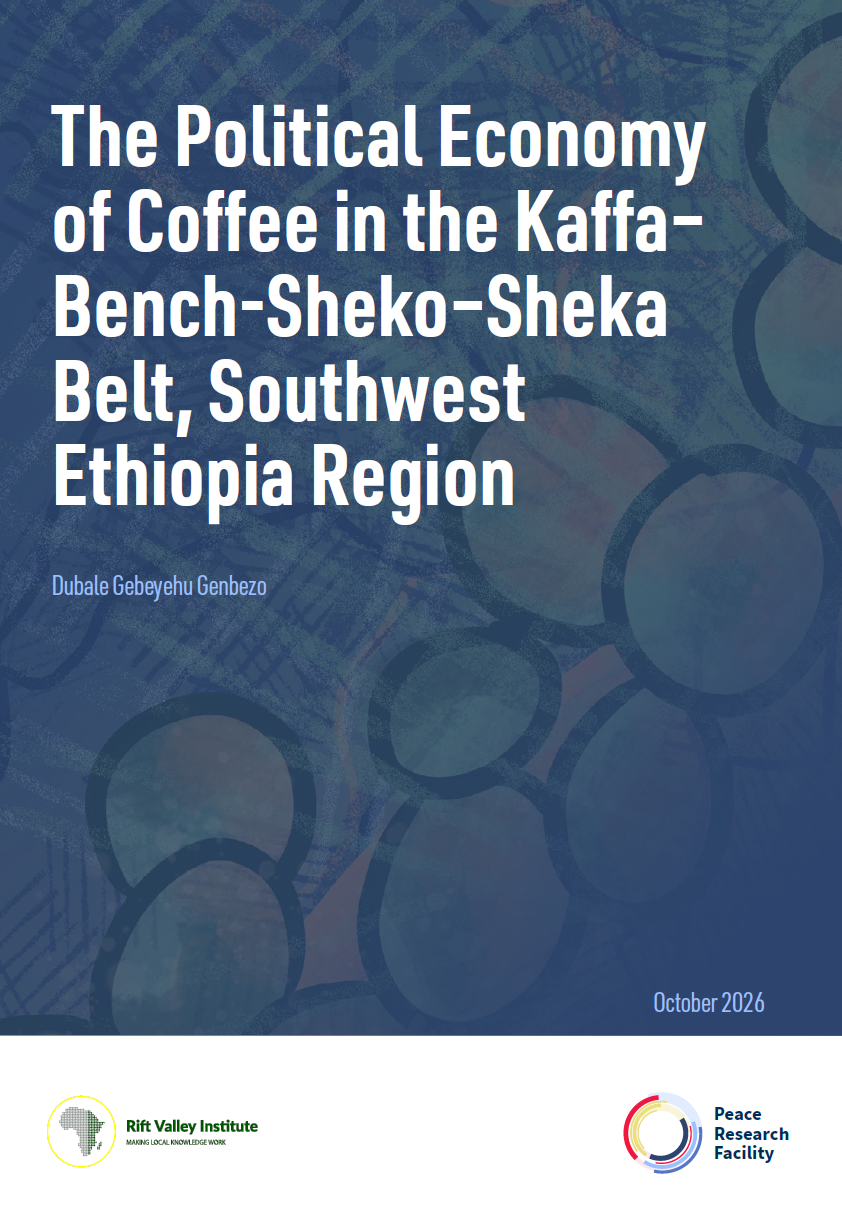
The Political Economy of Coffee in the Kaffa–Bench-Sheko–Sheka Belt, Southwest Ethiopia Region
October 6, 2026
This study provides a critical political economy analysis of the coffee sector in the Kaffa–Bench-Sheko–Sheka belt in Southwest Ethiopia Peoples’ Regional State, the genetic and cultural heartland of Arabica coffee (Coffea arabica). Based on 47 key respondent interviews, the study
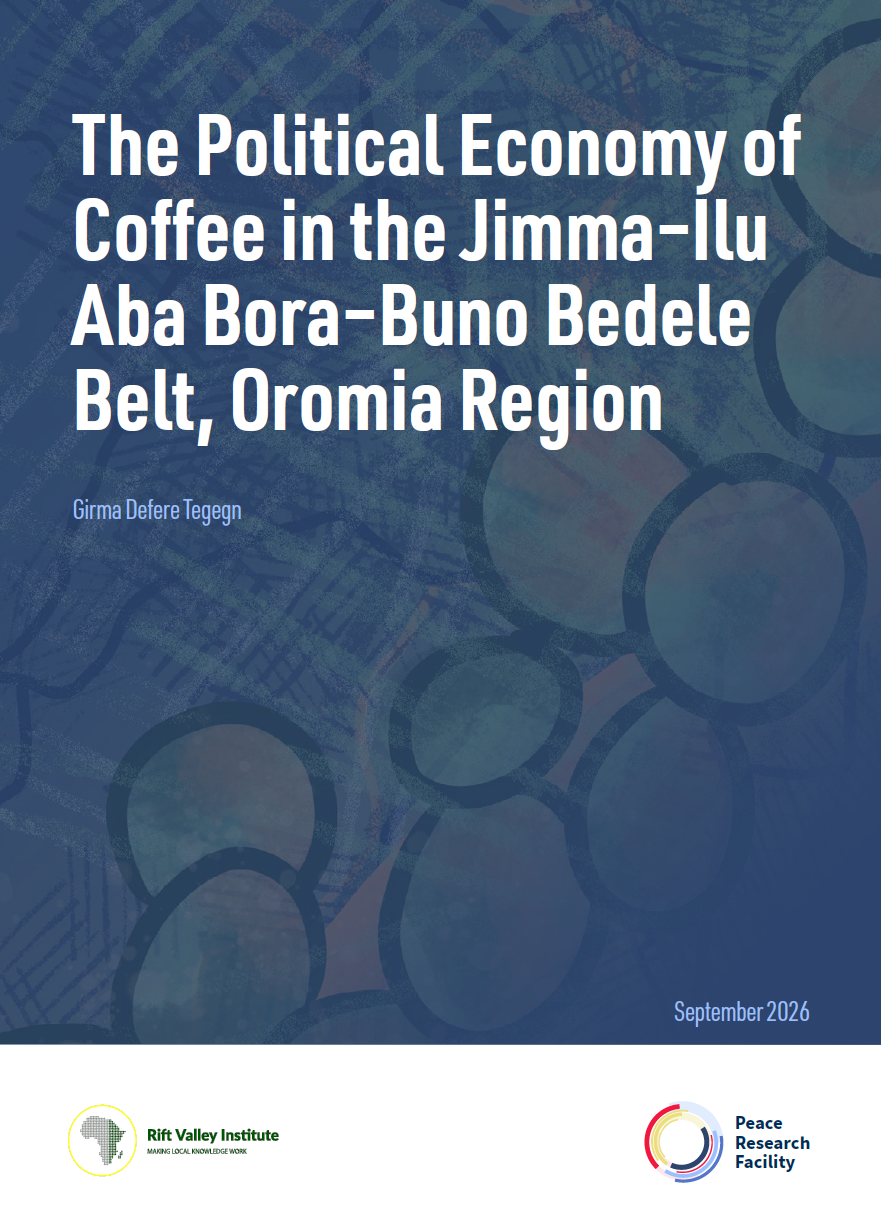
The Political Economy of Coffee in the Jimma–Ilu Aba Bora–Buno Bedele Belt, Oromia Region
October 5, 2026
The findings of this study reveal a number of critical insights about the political economy of coffee in the Jimma–Ilu Aba Bora–Buno Bedele coffee belt. The coffee economy is shaped by a small number of influential actors, including state institutions,