The research provides a snapshot of the war in Sudan in the period from February to April 2025. However, the war is dynamic, with political alliances and territorial control changing.
The April 2023 conflict between the Sudan Armed Forces (SAF) and the paramilitary Rapid Support Forces (RSF) marks the most horrible chapter in Sudan’s modern history. Although the epicentre of the conflict at the beginning was the capital city of Khartoum, the fighting advanced quickly into other regions, especially in western Kordofan and Darfur. These areas have since remained strongholds of RSF. Meanwhile, other rebel groups, especially the SPLM-N (al-Hilu) have seized the opportunity to re-activate armed opposition to the Government of Sudan, particularly in Blue Nile and South Kordofan states.
The conflict has its roots in the competition over the control of the state and its resources. It has been catastrophic, plunging the country into the world’s largest displacement and humanitarian crisis. More than 12.9 million people (27 per cent of the population) have been displaced and 30 million people (more than 60 per cent of the population) need lifesaving aid. In Kordofan and Darfur it has left civilians trapped, starving and without the basics they need for their survival. Social services have collapsed. Public and private properties, including banks, have been looted and the country’s industrial base severely damaged. Financial networks and information and communications technology (ICT) are down or are severely restricted, with disastrous impacts on food security and livelihoods. Education, health and water infrastructure has been decimated resulting in the rapid spread of cholera, measles and other diseases.
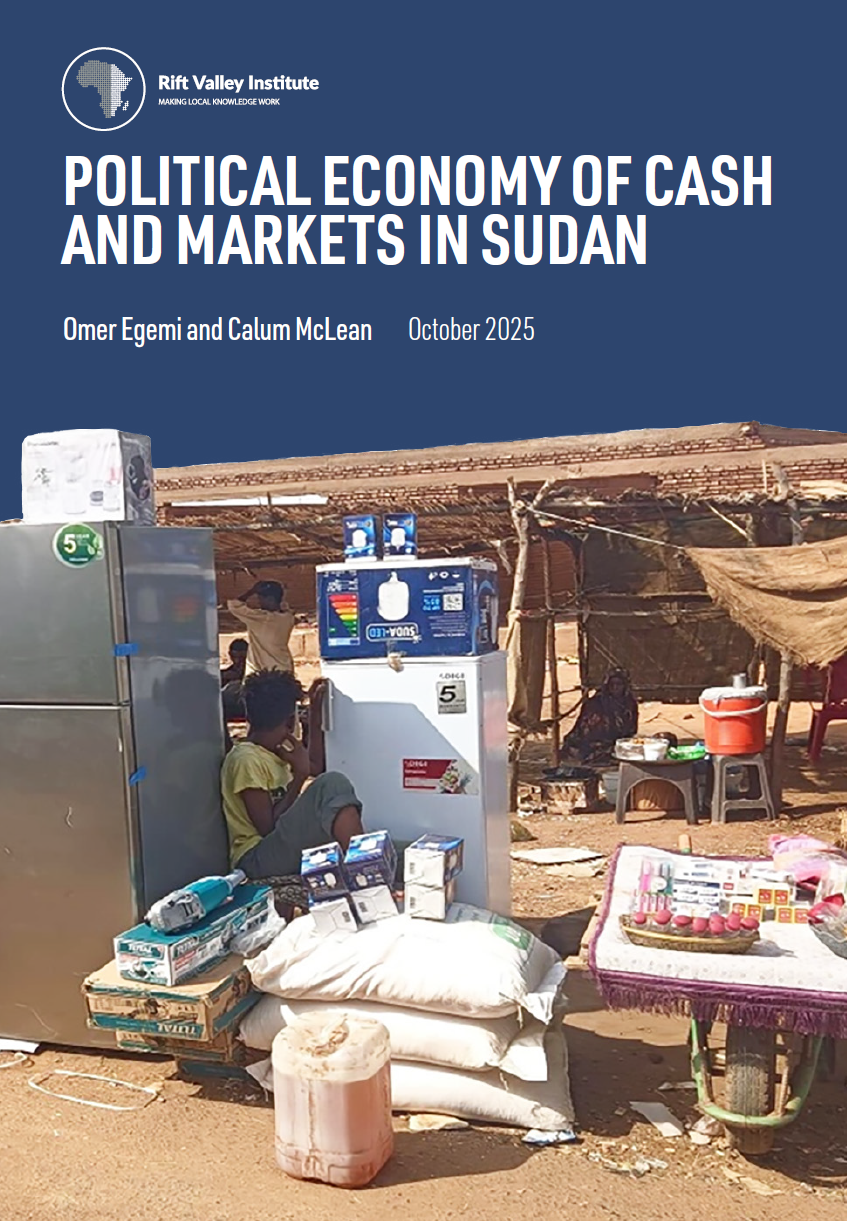
This study analyses the political economy dynamics shaping this crisis landscape, with particular focus on aspects affecting cash and markets. Sudan’s economy is largely controlled by warring parties. There is a need to ground the design of assistance within this reality for two aims: 1) maximizing support to marginalized populations and 2) limiting ways in which aid enriches parties to the conflict and further entrenching existing power dynamics. The study covers Khartoum, the political and economic hub of the country, and the two regions of Kordofan and Darfur that comprise the western part of the country. In the time since data was collected, the Khartoum context has shifted as SAF regained control of the city in May 2025. The study draws on a combination of quantitative and qualitative primary data collected through direct fieldwork covering 39 primary, secondary and terminal markets using individual and group interviews, key informant interviews, case studies and mapping. In total, 338 individuals (218 males and 120 females) participated. Field research took place from February to April 2025. Limited market access, insecurity, the sensitivity of information, and a high degree of mistrust around information sharing were significant challenges.
The economy is a central battleground in Sudan’s conflict. Traders are likely to have either pragmatic connections or affiliations with one or another of the warring parties. This makes it inevitable that humanitarian assistance becomes entangled with the war economy and will inadvertently contribute to it to a greater or lesser extent. Humanitarian actors have a responsibility to understand these dynamics, to minimize to the best extent possible how their actions contribute to armed actors’ revenue streams, as well as minimizing the protection or security risks faced by recipients of cash assistance: In other words, to find ‘least-worst’ options. There will often be trade-offs to consider when finding the ‘least-worst’ options that might affect the efficiency or effectiveness of the assistance and these need to be weighed against the humanitarian imperative of providing adequate assistance for people in need. Where these two contradict each other (e.g., a ‘least-worst’ option putting people at greater security risk), humanitarian actors need to prioritize the needs of affected people in line with humanitarian principles.
In areas where control has shifted and particularly where atrocities have occurred or are occurring—such as in West Darfur, West Kordofan and now North Darfur—the risks are higher. Pre-conflict traders may have been killed, displaced or forced out—and new market actors may be direct beneficiaries of violence. Humanitarians must recognize this dynamic and weigh the risks of inadvertently supporting perpetrators when engaging with local markets. This may mean enhancing assistance in locations of displacement and beyond immediate sites of heavy conflict and atrocities.
Regular monitoring should consistently assess contributions to the war economy, enabling humanitarians to make informed decisions on choosing the ‘least-worst’ options and adapt if risks arise. Methods could include social network analysis, mapping of gatekeepers and their influence and the continuous collection of primary data from merchants, suppliers and informal money agents. Sudanese staff and Sudanese partner organizations should play a central role, as they hold the deepest knowledge of the local political economy, acknowledging that there are no easy solutions even by the best informed.
Acknowledgements
The research was carried out and report written by Omer Egemi and Calum McLean, assisted by researchers in Sudan. The authors gratefully acknowledge peer review feedback from Margie Buchanan-Smith, Munzoul Assal, Musa Adam Abdul-Jalil, Mark Bradbury and Harry Cross. Joel Otieno provided project management support. The report was edited by Jason Mosley.