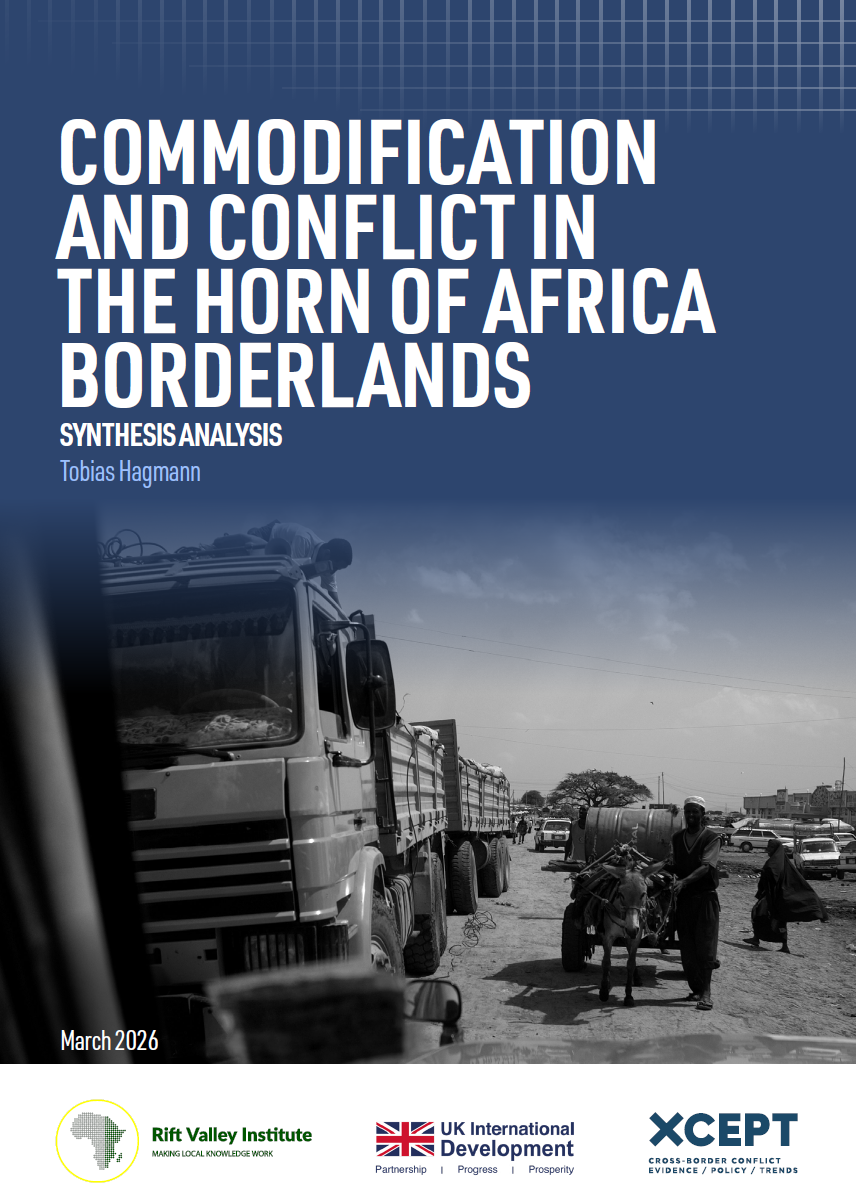
This report synthesizes findings from the Rift Valley Institute’s X-Border Local Research Network (2019–2025). In the surveyed studies, 25 leading local and international area specialists conducted extensive qualitative fieldwork across borderlands in South Sudan, Sudan, Ethiopia, Kenya and the Somali territories. Drawing on interviews with hundreds of interlocutors, these studies investigate the causes and consequences of conflict in border areas and how such conflicts connect across borders.
Taking the X-Border studies as its point of departure, this report asks two central questions. First, how do the different borderlands studied by X-Border relate to each other? Second, what do the X-Border studies contribute to the global borderland literature?
To answer these questions, the author positions the Horn of Africa’s borderlands within the global borderland scholarship; compares five distinct borderland configurations; analyses six key processes shaping them; and develops an emerging framework linking conflict and commodification, alongside policy-relevant conclusions.
Conceptually, the Horn of Africa’s borderland spaces cannot be understood in purely idiosyncratic terms or as expressions of their regional context. The global, including historical, borderland literature brought to the fore that borderlands are comparable, that political violence in borderlands is embedded in global historical forces, and that they are better understood through processes rather than as fixed geographical entities. Conflict and violence at the ‘margins of the state’ reflect evolving state formation dynamics that involve and are often initiated by the political centre.
As the X-Border studies highlight, this process is omnipresent in the Horn of Africa’s borderlands. As central authorities seek to expand or formalize control over ‘peripheries’, borderland communities resist or adapt in response, resulting in complex interactions between local and national actors. The diversity of the Horn of Africa’s many borderlands is reflected in the X-Border studies, which examine contested borderland processes across markedly different empirical contexts.
Horn of Africa Borderlands are configurations of multiple, overlapping boundaries that can be studied and compared empirically as a continuum of ‘borderland dynamics’ that range from ‘static’ to ‘fluid’. They consist of a set or matrix of interacting geographic, political, demographic, cultural and economic boundaries. A panoply of borderland dynamics becomes apparent when considering the internal boundary dynamics of the Horn of Africa’s borderlands. They range from more to less militarized; from shorter to global cross-border supply chains; from relatively simple, dyadic political contestation to complex, multi-scalar political competition; and from demographically homogenous to more heterogenous boundaries:
- Boundaries in the Northern Bahr el-Ghazal borderland are geographically, economically and demographically porous, but politically restrictive.
- While its geographical and political boundaries are restrictive, the demographic, cultural and economic boundaries of the borderland between Sudan’s Blue Nile State and Ethiopia’s Benishangul-Gumuz region are porous.
- Kenya’s north-eastern borderland between Mandera and Moyale is marked by geographically fluid boundaries.
- The Gulf of Aden maritime borderland spans between Yemen, the breakaway Republic of Somaliland and Puntland. Its geographical boundary is static as the land-sea divide is fixed. Its political boundary is restrictive, and its demographic, cultural and economic boundaries are porous.
- The Somali transnational borderland—the proverbial ‘greater Somali economy’—features porous geographical boundaries, fluid demographic, cultural and economic boundaries and political boundaries that range from restrictive to porous.
All borderlands are not created equal, but many borderlands are animated by comparable causal mechanisms producing an array of different empirical manifestations. Focusing on the Horn of Africa, the X-Border studies represent this expansive borderland diversity, but also the different ways in which commodification, resource control, logistics, financing, circulation and capture, and revenue generation operate.
Concomitantly, the studies bring to the fore the contemporaneous and global character of these borderlands and a co-occurrence of various conflict dynamics and supply chain capitalism. As ‘transmission belts’ they connect supposedly peripheral spaces with political centres and global networks, ensuring the region’s—often conflictual—integration into transnational flows. Different actors compete over the governance of these commodity flows and their associated revenue streams in and across borderlands. Borderland actors constantly need to insert themselves into these changing transnational dynamics driven by conflict, inflation, climate change and other macro dynamics.
The policy implications of the report emphasize the need for nuanced, context-specific approaches:
- First, policymakers must understand both the drivers and consequences of commodification and their varied impacts on conflict. Borderland dynamics have far-reaching effects beyond local contexts, as they connect to national economies and political centres through transnational flows.
- Second, interventions should avoid one-size-fits-all solutions and instead engage with the specific boundary configurations and social dynamics of each borderland.
- Third, policies should address the incentives that drive value capture and conflict, including the roles of state and non-state actors in shaping these dynamics.
- Finally, greater attention should be paid to financial systems and their role in enabling exploitation and conflict.
XCEPT programme
This synthesis study is a product of RVI’s Cross-Border Conflict Evidence, Policy and Trends (XCEPT) research programme. XCEPT brings together leading local and international experts to examine conflict-affected borderlands, how conflicts connect across borders, and the factors that shape violent and peaceful behaviour. The programme carries out research to better understand the causes and impacts of conflict in border areas and their international dimensions. Funded by UK International Development, XCEPT offers actionable research to inform policies and programmes that support peace, and builds the skills of local partners. The views expressed do not necessarily reflect the UK government’s official policies.