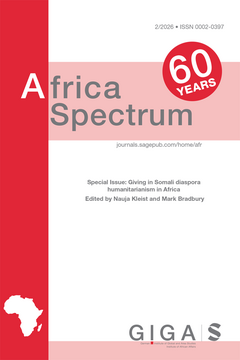
Research from a Rift Valley Institute project features in the latest issue of Africa Spectrum—Volume 61, Issue 2 (August 2026)—as part of a special issue on ‘Giving in Somali diaspora humanitarianism in Africa’. Guest edited by DIIS Senior Researcher Dr Nauja Kleist and RVI Executive Director Mark Bradbury, the collection examines how Somali diaspora communities across Africa mobilize care, solidarity and humanitarian assistance during times of crisis.
The special issue explores an often-overlooked dimension of humanitarian action: assistance organized by diaspora communities within Africa. Drawing on research from Somalia, Kenya, Uganda and Zambia, the contributions examine how people mobilize resources and provide support through networks of kinship, religion, business and digital technologies. The collection highlights how these forms of assistance are shaped by social relationships, mutual obligations and longstanding practices of solidarity.
It’s been very rewarding to collaborate with our PhD candidates on this important project. Their ideas, analytical insights and impressive fieldwork data have given the co-authored articles strength and depth that would not be possible otherwise. Together the articles constitute a collection of empirically grounded and theoretically informed case studies that deserves to be widely read by both scholarly and policy audiences.
— Dr Nauja Kleist
The issue brings together six research articles examining different forms and contexts of Somali diaspora humanitarianism. These include humanitarian relief organized by Somali businesswomen in Zambia in response to the 2020 floods in Puntland; mutual aid among the Somali-Ugandan community in Kampala during the COVID-19 crisis; mosque and kinship-based aid networks in Nairobi; and the use of WhatsApp groups to organize drought relief in Somalia. Other contributions examine patterns of crisis giving among Somalis in Eastleigh, Nairobi and the role of Somalia’s telecommunications sector in humanitarian assistance.
The mentorship and collaboration through D-Hum strengthened my research and contributed to the completion of my PhD. Seeing our work published in a respected journal such as Africa Spectrum is especially rewarding, bringing Somali communities’ experiences of giving, care and politics into wider scholarly and policy debates.
The special issue is an output of the Diaspora Humanitarianism in Complex Crises (D-Hum) collaborative research project, which involves a consortium including Danish Institute for International Studies, the Institute for Development Studies at the University of Nairobi, Rako Research and Communication Centre, and the Rift Valley Institute. The project examines how Somali diaspora communities mobilize, channel and deliver emergency assistance outside conventional international humanitarian systems. The research demonstrates the importance of understanding humanitarian action through the social, political and economic relationships that underpin giving and care.
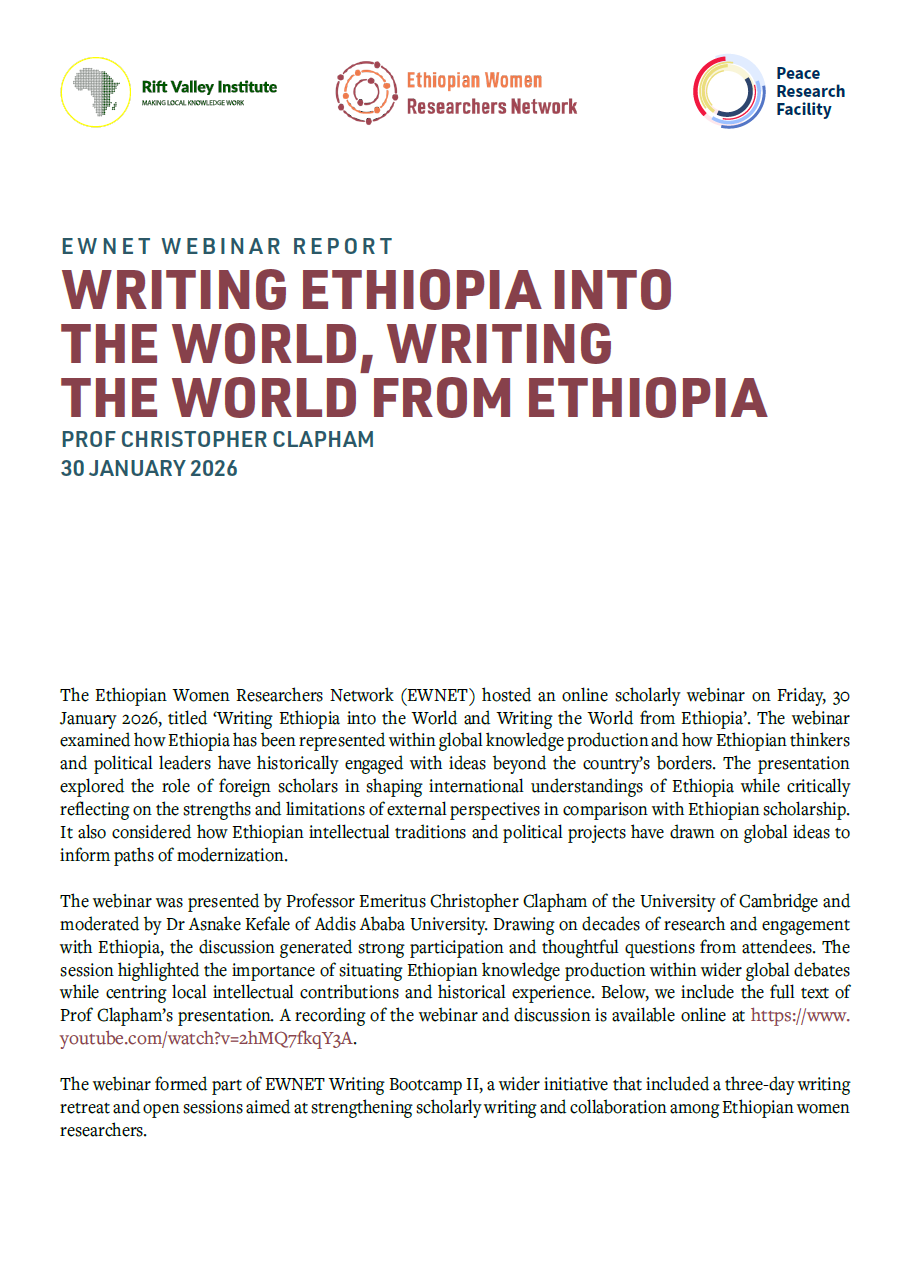
The Ethiopian Women Researchers Network (EWNET) hosted an online scholarly webinar on Friday, 30 January 2026, titled ‘Writing Ethiopia into the World and Writing the
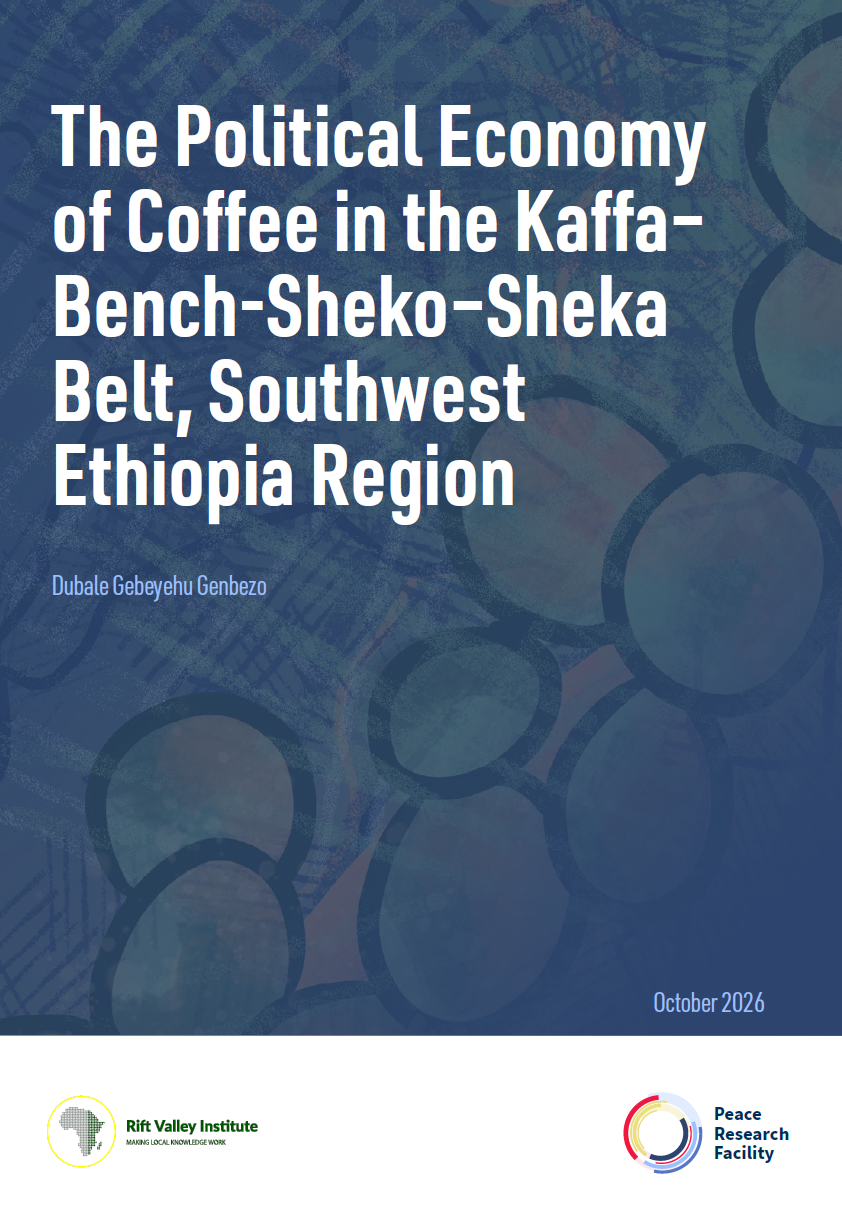
This study provides a critical political economy analysis of the coffee sector in the Kaffa–Bench-Sheko–Sheka belt in Southwest Ethiopia Peoples’ Regional State, the genetic and
The findings of this study reveal a number of critical insights about the political economy of coffee in the Jimma–Ilu Aba Bora–Buno Bedele coffee belt.