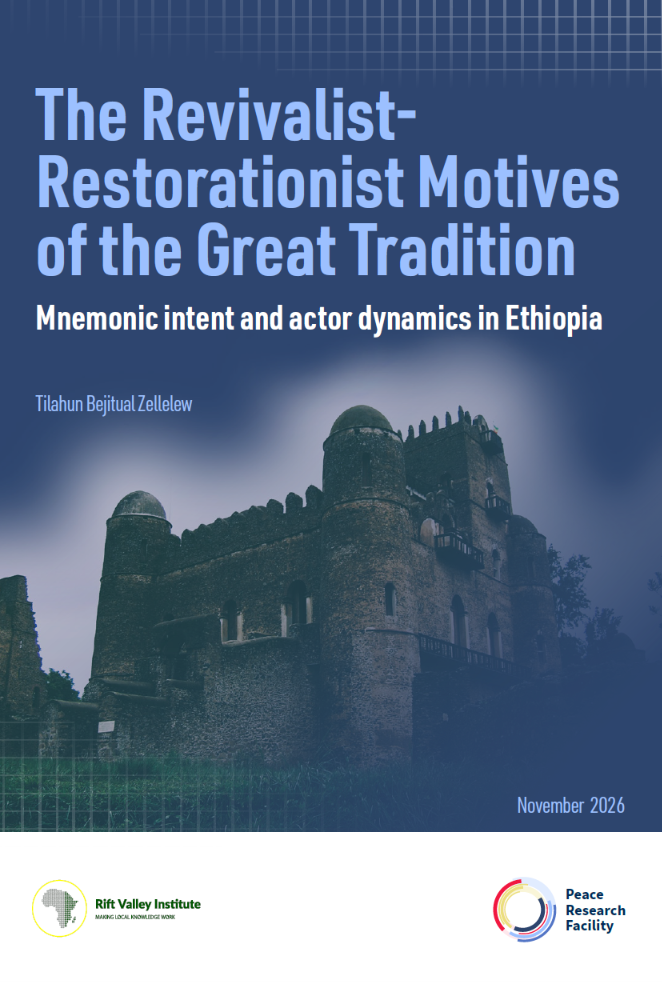
Tracing the genealogy and current state of revivalism and restorationism of the Great Tradition (GT) within the memory landscape in Ethiopia reveals dynamic mnemonic strategies and vocabularies that evolve across successive historical regimes and various state and non-state mnemonic agents.
Summary
Contemporary memory politics in Ethiopia is contested through the current administration’s selective revival of the GT. Utilizing frameworks like Manserarat (‘revival’) and Abwara Maragef (‘dusting off’), state-led nationalizing efforts physically reshape collective memory through transformative urban initiatives in the capital, such as the Adwa Victory Memorial Museum, the National Palace renovation and large-scale corridor developments, alongside the rhetoric of ‘nautical revival’ for sea access. These are memory projects that spark tensions among groups.
While influential social institutions adapt sacred rituals to meet contemporary existential anxieties, as seen through the lens of the ‘invention of tradition’ in the emergence of Ye’Aelafat Zimare (‘Melody of the Myriads’) within the revivalist verve of the Ethiopian Orthodox Tewahedo Church, modern pop culture, including music and social media, also play their role. They serve as an arena where the state’s retrospective projections find mnemonic convergence with popular yearnings for the return of a glorious past, manifested in mantras such as Tilik Neberen, Tilik Enhonalen! (‘We were great, we shall be!’), which has also been adopted by the government. Regional actors also engage in mnemonic re-engineering, selectively reviving elements of the GT while practising strategic amnesia regarding traumatic relations with previous regimes.
The Ethiopian memory landscape is characterized by mnemonic complexity. Distinct historical layers, including thirteenth century divine legitimacy (Kibre Negest), nineteenth century state sovereignty narratives and twentieth and twenty-first century unionist and ethno-nationalist motives, merge into a single messy memory battle. The competing and polarized memory blocs are not monoliths, however, but are shaped by intra-group and inter-group tensions, negotiations and contestations over interpretations of the past and present and competing visions of the future.
Successive regimes have gravitated toward the GT. Though they take power rejecting it as hegemonic and oppressive, the pragmatic demands of governing an ancient polity appear to force a turn to embracing, reviving and appropriating its symbolic repertoire. Consequently, the state’s engagement with the GT is often an ambivalent entanglement, concurrently delegitimizing the tradition to signal reform while drawing upon it to bolster state continuity and sovereignty.
An ingrained revivalist habitus appears to exist within the DNA of the Ethiopian state such that regimes consistently leverage the spatial and symbolic grandeur of historical Ethiopia for survival and pragmatism rather than ideological consistency.
Navigating divergent and contested memories in Ethiopia requires a transition toward mnemonic convergence and national individuation, allowing the nation to mature by integrating its historical shadow (both grandeur and traumatic grievances) to forge a resilient, pluralistic future. Moving toward national maturity requires a radical re-reading of the GT, transitioning it from a monument or target for destruction into an evolving, multi-vocal and accommodative framework of negotiation.
Outgrowing current memory battles necessitates shifting from the zero-sum logic of ethnic victimhood versus victorhood toward a negotiated national consciousness where historical pride and discomfort are recognized as inseparable aspects of the national experience. Thus governing divergent memories requires moving away from state-led monopolies and cycles of erasure toward institutionalizing a deliberative mnemonic project that embraces both a fragmented present and a complex, traumatic past.
The Ethiopia Peace Research Facility
This report was written for the Ethiopia Peace Research Facility (PRF), as part of its Knowledge for Peace (K4P) series on ‘The Politics of Memory and Memorialization’. Shimelis Bonsa Gulema served as advisor to this series. The PRF is an independent facility combining timely analysis on peace and conflict from Ethiopian experts with support for conflict sensitive programming in the country. It is managed by the Rift Valley Institute and funded by the UK government.