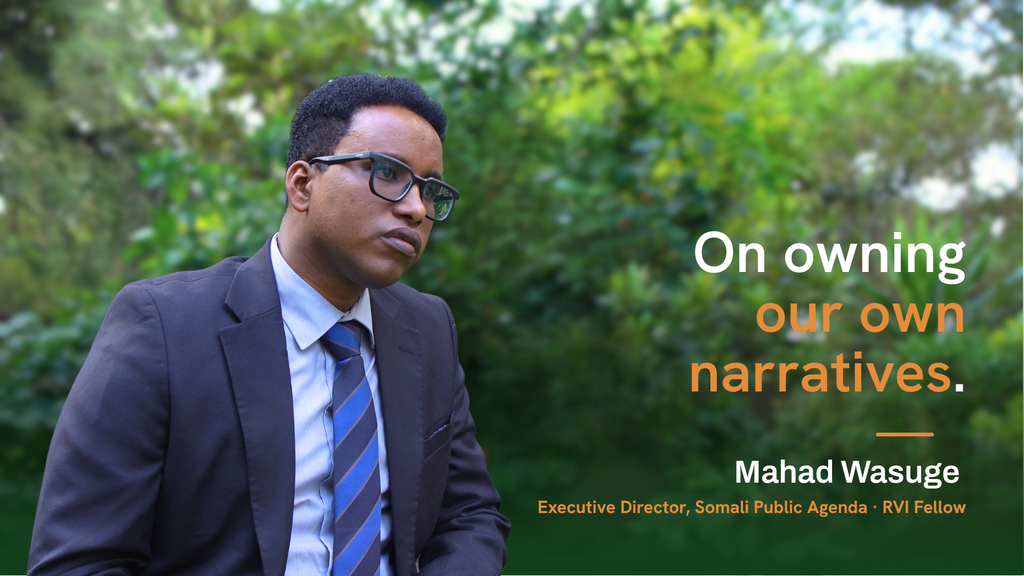
RVI Fellow Mahad Wasuge founded Somali Public Agenda in Mogadishu in 2018. He talks about why research on Somalia should be written by Somalis who live there, his memoir of growing up through conflict and the football match that ends every SPA course.
Mahad Wasuge’s engagement with RVI began in January 2014 in Hargeisa, at a week-long course for researchers working on several RVI projects. He was then a researcher at the Heritage Institute for Policy Studies (HIPS) in Mogadishu, and part of a joint RVI–HIPS team studying land disputes in the city. In the years that followed, he worked with RVI on several studies in Somalia, which he says ‘helped strengthen my research capacity’ and connected him ‘with researchers across the Horn of Africa and beyond’.
In January 2018 he founded Somali Public Agenda (SPA), the “think-and-do tank” he still leads as executive director. That year he also joined RVI’s Horn of Africa Course as a participant, and in 2022 he came back to teach on it. SPA’s own researchers have since trained with RVI, through its Early Career Researchers Training Programme and with scholarships to the Horn of Africa Course.
In an interview recorded in 2026 for RVI@25, marking 25 years of the Rift Valley Institute, he spoke about why research by Somalis living in Somalia matters, what institutions like SPA and RVI can do in uncertain times and a tradition that began on a football pitch.
‘We have to own our own narratives’
For Mahad, research grounded in place is not a preference but a necessity. ‘Locally grounded research is important for any community’, he says. ‘And it is important for Somalia because we have to own our own narratives’.
For years, he argues, most research on Somalia was written by people who did not live there. He pointed out that many came on short trips and spoke to few people. ‘That does not give a comprehensive picture of the issues that they are researching’, he says. SPA was set up partly to fill that gap.
‘Somali researchers writing about Somali issues is important, not only for the Somalis, but also for the outside world. For those interested in Somali issues, it is more beneficial to read studies authored by Somalis who live in Somalia.’
– Mahad Wasuge, founder and Executive Director, Somali Public Agenda
RVI was founded in 2001 on a similar conviction: that the communities of the region are communities of knowledge and practice, not simply communities of need, and that the people closest to an issue should be recognized as producers of knowledge about it.
Telling his own story
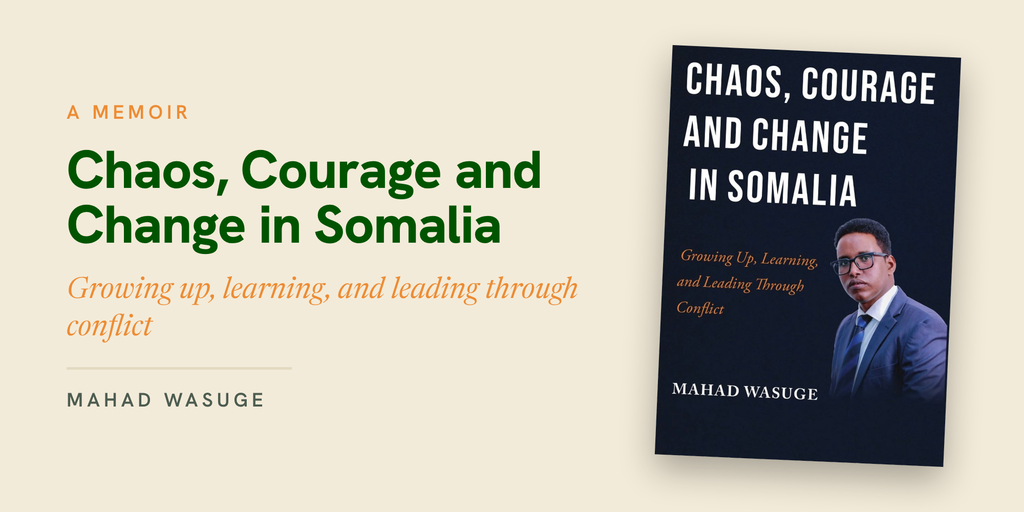
His memoir is one way of owning that narrative. Chaos, Courage and Change in Somalia: Growing up, learning, and leading through conflict follows his path from a small town in Somalia through education and research to public policy and the building of SPA.
‘I have never seriously considered leaving Somalia’, he writes. ‘If all of us who can afford to leave do so, who will remain to make the country a better place?’
Bringing researchers and policymakers together
Mahad counts the long-term collaboration between SPA and RVI’s Somali Dialogue Platform as his most significant engagement with RVI. ‘This partnership has been central to SPA’s research and knowledge production efforts, as well as to strengthening its institutional capacity’, he writes.
He sees convening as one of the most important things institutions like SPA and RVI do. The two have worked together for nearly six years and started a new two-year project in 2026. ‘The project enables us to convene dialogue in Kenya and in Somalia’, he says, bringing together ‘policymakers, researchers, intellectuals, donors’ to discuss the region. ‘That is very critical and important’.
‘I believe that this relationship has also contributed to RVI’s decision to welcome me into its Fellows community’, he adds.
A football match at the end of every course
Asked for a favourite memory from his time with RVI, Mahad went back to the Horn of Africa Course. At the end of each course, instructors and participants form one team and play a team from the hotel hosting the course, whether in Naivasha in Kenya, Entebbe in Uganda or Bishoftu in Ethiopia. ‘That was something exciting and that is still in my head’, he says.
The tradition travelled. When SPA set up its own training programme, the SPA Learning Lab, it brought the match with it. Every SPA course now ends with a game between SPA staff and the graduates, in two sets of uniforms.
Conversations with our network is a series about people connected to RVI and their work. It began in 2026, as part of the RVI@25 campaign.
Somali Public Agenda | About the book | Somali Dialogue Platform | RVI courses RVI Fellows | RVI@25
| Support our work RVI courses and research partnerships have been part of Mahad’s work since 2014. Help sustain research, learning, public dialogue and cultural work rooted in local knowledge across eastern and central Africa. Donate to RVI |