Terms of reference
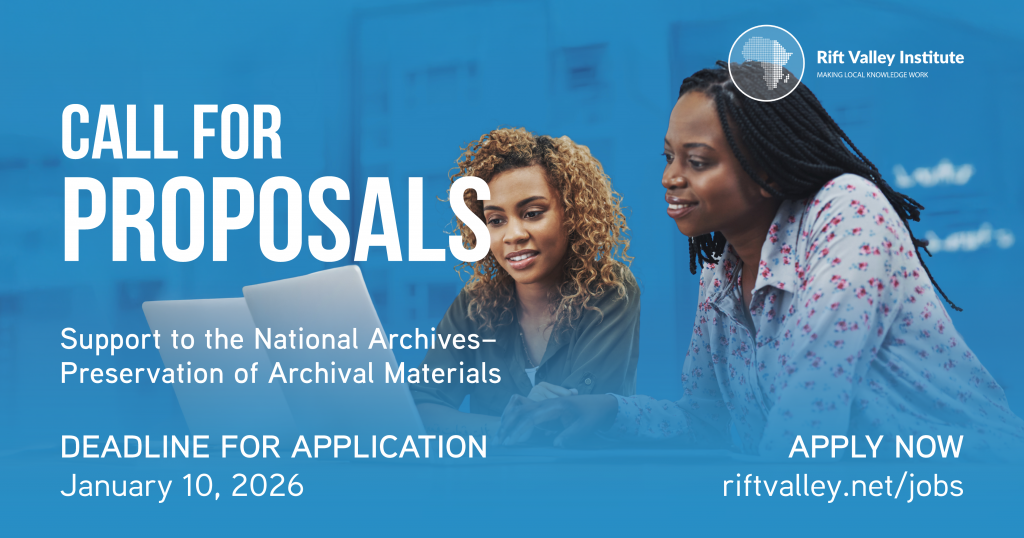
RVI seeks to contract consultancy services to design and implement the end of project evaluation for the South Sudan National Archives Project funded by the Norwegian Ministry of Foreign Affairs through the Royal Norwegian Embassy in Juba (November 2023–December 2025).
Background
The South Sudan National Archives (SSNA) Project is a multiphase project for the conservation, reordering, cataloguing and digitization of the historical government records of South Sudan, implemented by the Rift Valley Institute (RVI) in partnership with the Ministry of Culture, Museums and National Heritage through the Directorate of National Archives and Antiquities with support from the Royal Norwegian Embassy in South Sudan.
The project has supported the cleaning, ordering, boxing and cataloguing of the documents in the Archive, which number tens of thousands, date from the colonial era up to the 1980s, and cover political, social and administrative issues at local and regional level over a period of 80 years. The aim of the project is to safeguard the documents, with a view to eventually installing them in the National Archive building when it is constructed. Since the independence of South Sudan in 2011, the Government of Norway has made a commitment to support the construction of a permanent South Sudan National Archive Building, which is currently at the design stage.
Between 2012 and 2022, RVI supported the National Archives to digitize approximately 60 per cent of the entire archives. In November 2023, RVI received funding from the Royal Norwegian Embassy in Juba to digitize the remaining 40 per cent of the archives while also sorting any remaining loose papers. The project was subsequently extended twice and is now due to end on 31 December 2025.
Purpose of the evaluation
The purpose of this evaluation is to establish whether the work that has developed under the SSNA since 2023 has contributed to advancing the overall project goal, and to generate recommendations for future directions.
Objectives and evaluation questions
Use OECD/DAC’s evaluation criteria to frame the objectives and questions along the following areas (coherence, relevance, effectiveness, efficiency, impact, sustainability).
Scope of the evaluation
The evaluation will consider all components of the project from 2023-2025 and assess all project activities, namely:
- upgrade and maintenance of the digitization equipment;
- development of digitization plan to guide the process of digitization over the period of the project;
- ensuring accurate recording of metadata, effective use of the Network Attached System (NAS), and safe back-up of data;
- providing support for cataloguing; and
- conducting staff and internship trainings.
Evaluation methodology
The evaluator will be expected to develop a creative, participatory methodology tailored to the South Sudan context and the long-term nature of the project under evaluation in collaboration with the RVI South Sudan staff. The methodology should however, include:
- desk review of project documents, policies and literature;
- consultations with key stakeholders through key informant interviews and focus group discussions as appropriate;
- stakeholder validation workshop to get feedback on key findings and recommendations; and
- compilation of final evaluation report that captures lessons learnt and makes recommendations on future directions in strengthening the National Archives.
The evaluator will ensure effective engagement with key stakeholders in the project, in particular:
- project managers;
- staff of the Ministry of Culture, Museums and National Heritage in Juba;
- staff of the Directorate of National Archives and Antiquities;
- interns, mentors, facilitators and trainers on the project;
- researchers (both nationals and internationals);
- educationists with knowledge of the archives;
- donor(s); and
- UNESCO.
Evaluation tasks and deliverables
The evaluator will perform the following specific tasks:
- Develop an inception plan (5-7 pages) describing the technical approach and data collection tools to be used in conducting the evaluation and outlining the work plan. The inception plan shall also present an outline of the structure of the evaluation report.
- Develop a draft report and share the same with RVI for review and feedback.
- Make a presentation of the main findings, conclusions and recommendations to RVI and key stakeholders and capture feedback from them to inform development of the final report.
- Develop a final evaluation report (of not more than 20 pages, excluding Annexes).
Consultant profile / experience
This assignment is open to qualified individuals and consultancy companies, who meet the following criteria:
- strong understanding of the context of South Sudan with experience of working in the country;
- proven experience in conducting evaluations of long-term development projects in conflict and fragile affected states with skills in creative methods of data collection, validation and analysis;
- fluency in written English (which is essential), with knowledge of Arabic or local languages an asset; and
- some experience handling, managing or researching archives.
All consultants and service providers to RVI are required to comply with RVI’s Anti-Bribery and Transactional Compliance Policy.
Timeline and proposed budget
To start as soon as the contract is signed, with first report draft due by 10 February 2026.
Interested persons should submit a technical and financial proposal by 10 January 2026 to Michael Odhiambo (Michael.odhiambo@riftvalley.net), with copies to Alex Miskin (Alex.Miskin@riftvalley.net) and Benjamin Deng (Benjamin.Deng@riftvalley.net).
Please note that only short-listed candidates will be contacted.
About the Rift Valley Institute
The Rift Valley Institute (RVI) is an independent, non-profit organization, founded in Sudan in 2001, currently working in eastern and central Africa. The aim of the Institute is to advance useful knowledge of the region and its diverse communities, bringing a better understanding of local realities to bear on social and political action. The RVI works with institutions in the region to develop and implement long-term programmes that combine action-oriented research with education and public information.