Seminar report
Rethinking Ethiopia, a collaborative essay competition initiative between Addis Ababa University’s Institute for Peace and Security Studies (IPSS) and the Rift Valley Institute’s (RVI) Peace Research Facility (PRF), offers a platform for Ethiopian youth to express their ideas and improve their writing skills.
The first round of the initiative took place in 2023–2024, with the accompanying seminar conducted on 22 February 2024—coinciding with the 50th anniversary of the 1974 Ethiopian Revolution. The full seminar report and Amharic, Oromo, Tigrigna and Somali translations of the essays can be found on the RVI and IPSS websites.
In this second round (2024–2025), Ethiopian youth (aged 18–30) were invited to compose a 1,500–2,000 word essay written in Amharic, Afaan Oromo, Tigrigna, Somali or English on the place of youth in Ethiopia’s political space. The topic was intended to open up discussion around youth engagement in a political context often characterized by gerontocracy. Against this backdrop, entrants from a wide range of academic backgrounds submitted essays on subjects as diverse as the quest for new political imaginings; the relationship between youth and security dynamics; and youth’s dual role as both protagonist and victim of political conflict. The call for ideas was advertised on various social media sites on 27 September 2024, with the original submission deadline of 25 October subsequently extended to 8 November.
More than 30 essays in various languages were submitted by essayists from across Ethiopia, including Addis Ababa, Oromia, Amhara, Somali, Sidama and Tigray. A panel of four IPSS and RVI representatives reviewed the submissions based on originality, progressive value and clarity of thought, especially regarding proposed recommendations. Ensuring a diversity of voices (societal, gender) was also a key consideration. The panel then selected 13 semi-finalists, each of whom received a writing mentorship to help refine and shape their essays. The mentors, all esteemed Ethiopian academics—Dr Eyob Balcha, Dr Netsanet Gebremichael, Dr Kiya Gezahegn, Dr Selam Esayas and Debela Fituma—were selected for their expertise, diverse educational backgrounds and willingness to mentor the young contributors.
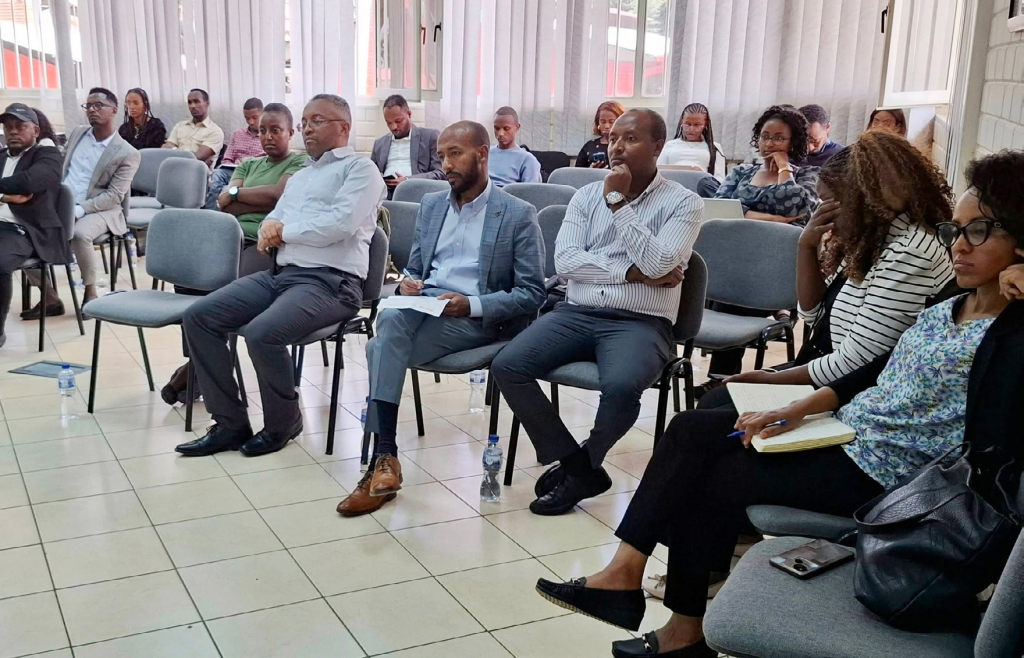
Following the six-week mentorship process, the mentees submitted their final essays on 10 February 2025. These were reviewed by the four-person IPSS/RVI panel, who selected the five best essays for presentation at the April 2025 seminar with a view to eventual publication. The previously applied criteria of originality, progressive value and clarity of thought were again used to select the five finalists: Fikir Getachew, Wakjira Tesfaye and Awol Ali (all postgraduate degree holders); Megdelawit Getahun (an LLB graduate); and Dina Abebe (an undergraduate student in her final year at Ambo University). Fikir and Megdelawit are based in Addis Ababa; Awol is from Hawassa in Sidama; Dina is based in Ambo in Oromia; and Wakjira is from Haramaya but currently based in the United States.
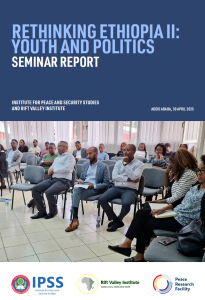
On 30 April 2025, RVI and IPSS convened a seminar entitled ‘Rethinking Ethiopia: Youth and Politics’. This not only allowed the finalists to present their work to a wider audience, but provided space for soliciting reflections on the place of youth in Ethiopian politics.
The seminar consisted of three main segments, the first of which was an opening session kicked off by a greeting from the IPSS’s Dr Fana Gebresenbet, followed by opening remarks from the RVI’s Dr Semir Yusuf and a keynote speech by Natnael Feleke. Next came involved presentations from the five essay finalists. Finally, there was a panel discussion on the theme of ‘Youth and Ethiopian Politics, Youth in Ethiopian Politics’, with remarks by Tsion Engdaye, Kulsma Nur and Tekrim Ahmed. Both the presentations and panel discussion were followed by audience question-and-answer sessions.
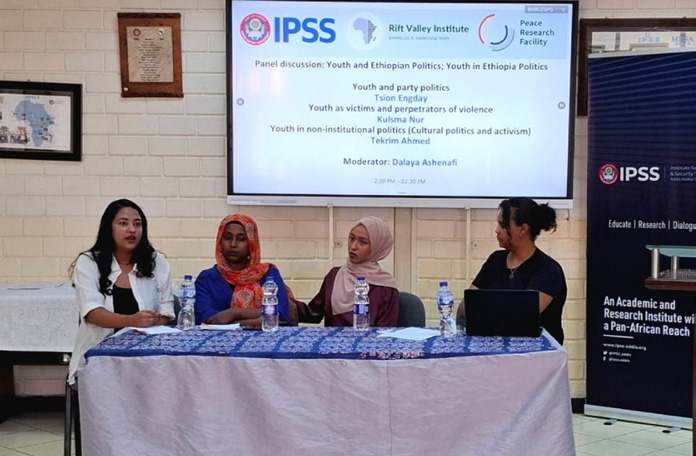
Semir closed out the seminar with some concluding remarks, including a call for continued reflection and engagement. The seminar moderators were Dr Messash Kassaye, Anteneh Tesfahun and Dalaya Ashenafi. The seminar was recorded and reported by IPSS’s Sofanit Ayu and Fikir Gezahagne.
Acknowledgements
The organizers wish to extend their sincere appreciation to all the individuals and institutions that contributed to the seminar’s success. Special thanks go to the essay finalists, panellists, moderators and reviewers, who dedicated their time and expertise. The audience’s support and participation, as well as the cooperation of the Institute for Peace and Security Studies, the Peace Research Facility and other affiliated organizations, was instrumental in making the seminar a meaningful and productive event.
The Institute for Peace and Security Studies (IPSS)
The Institute for Peace and Security Studies (IPSS) at Addis Ababa University is the premiere institute for education, research and policy dialogues on peace and security in Africa. Our mission is to offer quality education and capacity training in the specialised field of peace and security to students and other stakeholders, as well as foster peace and security through research, dialogue and other outreach activities in Ethiopia and across Africa.
The Ethiopia Peace Research Facility
The Ethiopia Peace Research Facility (PRF) is an independent facility combining timely analysis on peace and conflict from Ethiopian experts with support for conflict-sensitive programming in the country. It is managed by the Rift Valley Institute (RVI) and funded by the UK government.